

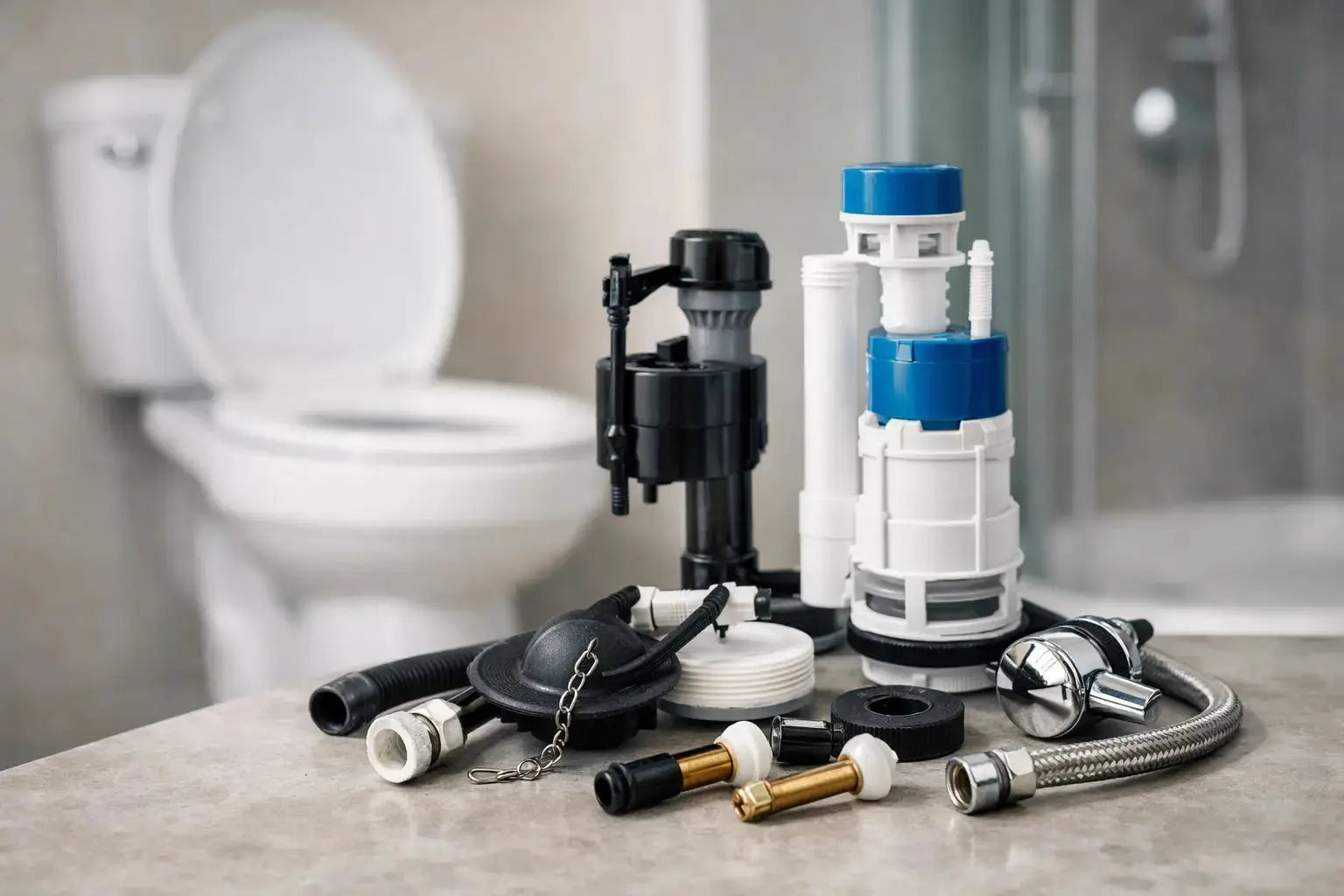
A toilet that runs all night, flushes weakly, or leaks at the base usually does not need full replacement. In many cases, the fix is simpler - and less expensive - if you identify the correct component first. This toilet replacement parts guide is built for that exact job: helping homeowners, renovators, plumbers, and facility buyers match common symptoms to the right part without guessing.
The key is understanding that toilets are not one universal system. Two-piece, one-piece, wall-hung, skirted, pressure-assisted, and concealed tank models can all use very different internal parts. Even within standard gravity toilets, fill valve height, flush valve size, trip lever orientation, and seat compatibility can vary by brand and model.
How to use this toilet replacement parts guide
Start with the symptom, not the part name. If the toilet keeps refilling, the issue may be the flapper, flush seal, fill valve, or water level setting. If it leaks onto the floor, the problem could be the wax ring, closet bolts, tank-to-bowl gasket, or a cracked component. Buying parts by assumption often leads to a second order and more downtime.
It also helps to separate visible trim from functional internals. A handle may look like the problem, but the actual failure could be the lift chain or canister seal inside the tank. Likewise, a wobbling toilet may seem like a bowl issue when the real cause is a failed flange, loose mounting hardware, or an uneven floor.
The most common toilet replacement parts
Fill valves
The fill valve controls how the tank refills after a flush. When it wears out, you may hear hissing, intermittent refilling, slow tank recovery, or constant water movement. Universal fill valves work for many standard toilets, but not all. Tank height, water connection position, and clearance inside compact tanks all matter.
For older branded toilets, direct-fit parts are often the safer choice. Premium brands may use proprietary assemblies designed around a specific tank shape or flush performance target. If the toilet is newer or design-forward, confirming model compatibility before ordering is worth the extra minute.
Flappers and flush seals
This is one of the most frequently replaced toilet parts. A worn flapper or seal lets water leak from the tank into the bowl, causing phantom refills and higher water use. The challenge is that not every toilet uses a basic flapper. Some use canister seals, tower seals, or brand-specific flush valve gaskets.
Material matters here. Rubber components harden over time, especially in areas with mineral-heavy water or aggressive cleaning tablets in the tank. If the toilet is running and the fill valve seems fine, the flush seal is often the first component to inspect.
Flush valves
The flush valve releases tank water into the bowl. If the toilet has a poor flush, a leaking tank, or a damaged valve seat, replacing only the flapper may not be enough. Flush valves come in different diameters, commonly 2-inch and 3-inch, and that measurement affects performance and fit.
A larger valve generally allows a faster, stronger release of water, but only if the toilet was designed for it. This is not an upgrade category where bigger automatically means better. Matching the original configuration is usually the right call.
Trip levers and push buttons
Handles break, loosen, corrode, or stop lifting the flush mechanism properly. On standard toilets, replacing the trip lever is usually straightforward, but orientation matters. Left-hand, front-mount, and side-mount configurations are not interchangeable in every tank.
For dual-flush toilets, the button assembly is more specialized. The visible button may be the issue, but on some systems the actuator rods or the valve body beneath it are the real wear points. Dual-flush repairs often reward exact model matching over universal substitution.
Wax rings, seals, and closet bolts
If water appears around the toilet base after flushing, the floor seal is a likely suspect. Traditionally that means a wax ring, though wax-free seals are also used in some installations. The right choice depends on flange height, floor finish, and how stable the toilet is once set.
Closet bolts matter more than many buyers expect. Corroded or undersized hardware can affect alignment and long-term stability. If the toilet is being lifted to replace the seal, changing the bolts at the same time is usually practical.
Tank-to-bowl gaskets and hardware
On two-piece toilets, leaks between tank and bowl are commonly caused by deteriorated gaskets or failing bolt sets. If the tank rocks slightly, drips after flushing, or shows rust around hardware, replacing the gasket and bolts together is often the cleaner repair.
This is another area where generic kits can work, but only when dimensions match. Bolt spacing, gasket profile, and porcelain shape differ across manufacturers.
Toilet seats and mounting kits
A toilet seat is technically a replacement part, but it is often purchased as an upgrade as much as a repair. Standard round and elongated seats cover many applications, yet seat fit is not just about shape. Hinge spread, quick-release hardware, soft-close function, and brand-specific profiles can all affect compatibility.
For commercial settings, durability and cleanability may outweigh aesthetics. For residential renovations, finish, hinge style, and comfort often carry more weight.
Brand compatibility matters more than many buyers expect
A major mistake in toilet repair is treating every tank interior as interchangeable. Some brands use highly standardized components. Others use proprietary valves, seals, and actuators designed for performance, water efficiency, or compact tank layouts.
That matters especially with brands such as TOTO, where flush systems may use canisters, specialty seals, or model-specific service kits. If you are replacing internals in a builder-grade gravity toilet, a universal part may solve the issue quickly. If you are servicing a premium toilet, a concealed tank, or a dual-flush design, exact matching is usually the better path.
If the original part has a number stamped on it, use that. If not, the toilet model number inside the tank or under the lid can narrow the search significantly. Product photos also help, particularly when comparing gasket shapes, handle styles, and valve assemblies.
When universal parts make sense
Universal parts have a place. They can be cost-effective, easy to source, and perfectly suitable for common fill valve or flapper replacements in standard gravity toilets. For service professionals handling older stock, they can also save time.
But universal does not mean risk-free. Fit may be technically possible while performance suffers. A toilet may stop leaking but refill noisily, flush weakly, or require adjustment that the original assembly did not. For customer-facing spaces or higher-end bathrooms, those trade-offs are not always worth it.
A practical buying checklist
Before ordering, confirm five details: toilet brand, model if available, part type, key dimensions, and whether the toilet uses a standard gravity or specialized flush system. For base leaks, check flange condition and floor height. For tank leaks, inspect both the moving parts and the gaskets around them.
It is also smart to replace connected wear items together when labour overlaps. If the tank is already apart, replacing the flapper and fill valve at the same time can be more efficient than revisiting the same toilet a month later. If the toilet is removed from the floor, new bolts and a new seal are usually sensible.
Repair or replace the whole toilet?
Sometimes a part replacement is the right answer. Sometimes it is just delaying a full fixture change. If the porcelain is cracked, the trapway is chronically problematic, parts are discontinued, or water consumption is far above current standards, replacing the toilet may offer better value.
The same applies during renovations. If the bathroom is being redesigned, it may be more practical to move directly to a new fixture that fits the updated layout and finish plan rather than invest in multiple repairs on an older unit.
For straightforward maintenance, though, replacement parts remain the fastest route back to proper operation. A well-matched valve, seal, gasket, or seat can extend service life considerably without the cost and disruption of changing the entire toilet.
A good parts search is really a fitment exercise. The more precisely you identify the toilet and the failed component, the more likely the repair goes in once and performs as expected. For buyers who want access to both everyday repair items and brand-specific toilet components in one place, Plumbing Market makes that process easier to manage. The best result is not just getting a toilet working again - it is getting the right part the first time.


