

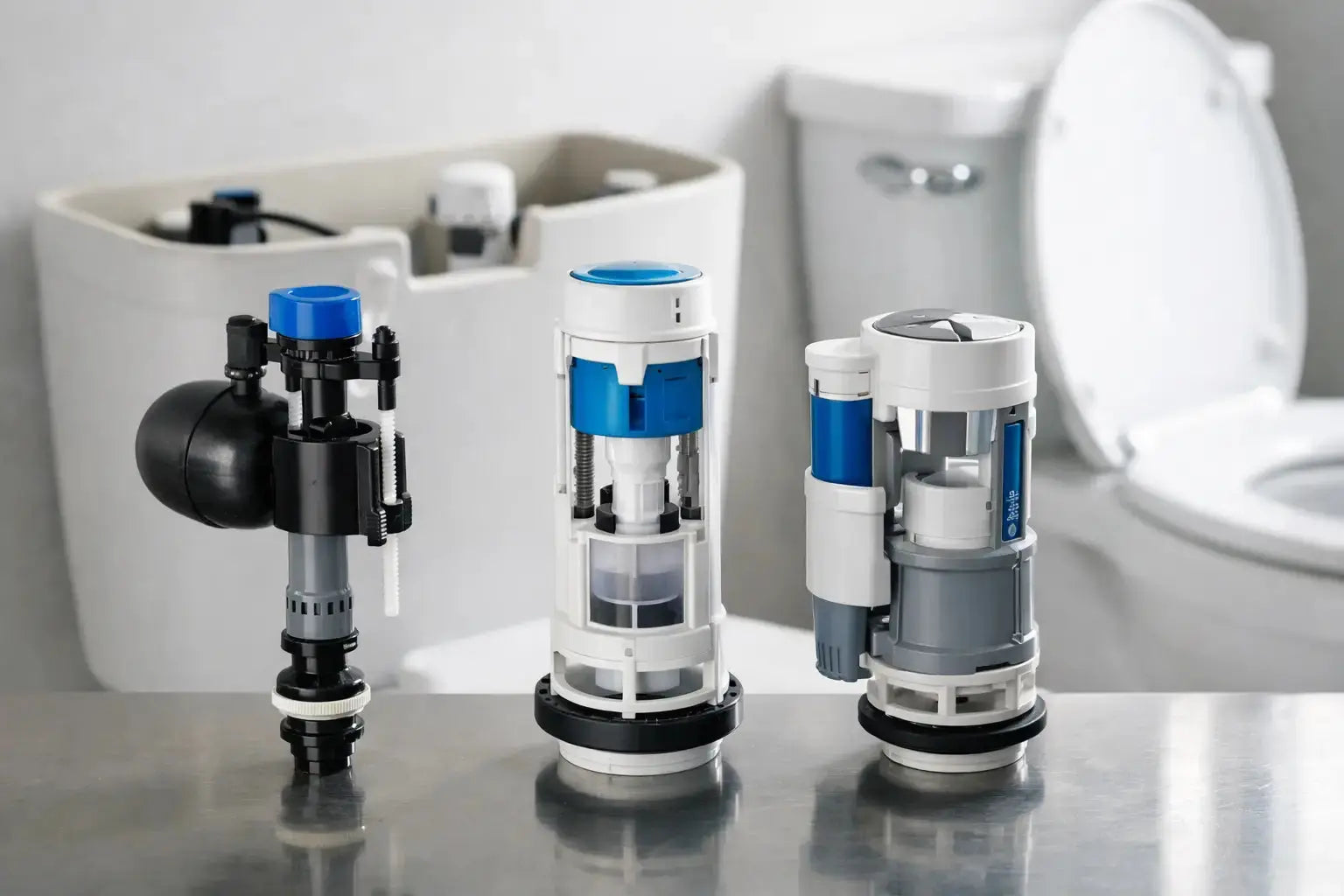
A toilet that runs after flushing, delivers a weak flush, or needs a second push of the handle often has a flush-valve issue rather than a complete toilet failure. Knowing the main toilet flush valve types helps homeowners, renovators, and trade buyers identify the right replacement part before ordering. The key is not choosing the newest-looking valve. It is matching the valve style, outlet size, actuator, and flush performance requirements of the toilet already installed.
For a standard tank toilet, the flush valve is the component at the bottom of the tank that releases water into the bowl. In commercial installations, the term may also refer to the flushing mechanism inside a flushometer valve. These products serve the same purpose but are not interchangeable.
Main Toilet Flush Valve Types
Flapper flush valves
A flapper flush valve is the most familiar style in residential toilets. It uses a rubber or silicone flapper connected to the trip lever by a chain. When the handle is pressed, the chain lifts the flapper, allowing tank water to flow rapidly through the flush-valve opening and into the bowl. As the tank empties, the flapper settles back onto the valve seat and seals the outlet.
This design is widely used because it is economical, straightforward to service, and available in many replacement configurations. In many cases, a leaking flapper can be replaced without removing the tank from the bowl. However, the flapper itself must match the valve opening and hinge arrangement. A universal replacement may work for some toilets, but it can close too quickly, fail to seal properly, or deliver the wrong volume of water on a toilet with a proprietary design.
Flapper valves are commonly paired with 2-inch outlets, although larger versions are also available. If a toilet runs intermittently and the fill valve activates without anyone flushing, a worn, warped, mineral-stained, or poorly seated flapper is a likely cause.
Canister or tower flush valves
Canister flush valves, also called tower valves, use a cylindrical seal that lifts vertically instead of swinging open on a hinge. The valve creates a wide, unobstructed opening around the base of the canister, which can release water quickly and support a strong bowl wash.
This style is common on many newer premium and high-performance toilets. It has fewer issues with a flapper twisting or catching, and the seal is often replaceable from inside the tank. The trade-off is compatibility. Canister assemblies and replacement seals are frequently brand-specific, so the toilet model or existing valve part number matters. Do not assume a generic flapper will replace a tower-style assembly.
A tower valve may be the better option where the original toilet was engineered for it, particularly on models with a large flush outlet. For repair work, retain the original operating style unless the manufacturer confirms another assembly is compatible.
Dual-flush valves
Dual-flush valves provide separate partial- and full-flush settings. They are most often found in modern water-saving toilets, including many skirted and contemporary designs. A partial flush is intended for liquid waste, while a full flush releases more water for solids.
The mechanism may use two push buttons in the tank lid, a top-mounted actuator, or a dedicated dual-flush lever. Internally, some systems use a tower valve with adjustable lift heights; others use a cartridge-style mechanism. The exact design varies considerably by manufacturer.
For Canadian buyers, flush volume is a useful selection point. Toilets and components may be rated in litres per flush, often shown as Lpf. Replacing a dual-flush valve with an incompatible single-flush assembly can affect performance, water use, and the fit of the actuator. If the toilet has a top-mounted button plate, confirm the button spacing, cable or rod configuration, tank-lid thickness, and valve height before selecting a replacement.
Large-outlet flush valves
Flush valves are also differentiated by outlet diameter. Common residential sizes include 2-inch, 3-inch, and 4-inch openings. The measurement refers to the opening at the base of the tank, not the diameter of the flapper alone.
A 2-inch valve remains common and offers broad replacement-part availability. A 3-inch or 4-inch valve can move more water in less time, which may help a toilet achieve a stronger flush with a lower tank volume. Larger is not automatically better for every toilet. The bowl, trapway, rim wash, and tank design all work together, so the replacement valve should match the original outlet size and intended flush system.
Measure the existing opening or check the toilet manufacturer's documentation before ordering. Installing a smaller valve on a larger opening will not seal correctly. Installing a larger assembly where the tank was not designed for it is equally impractical.
Tank Flush Valves vs. Commercial Flushometer Valves
Residential gravity toilets store water in a tank above the bowl. Their flush valves release that stored water by flapper, canister, or dual-flush mechanism. A commercial flushometer toilet or urinal operates differently. It connects directly to the water supply and uses line pressure to deliver a controlled flush.
Commercial flushometer valves generally use either diaphragm or piston operating assemblies. A diaphragm system uses a flexible rubber diaphragm to regulate water flow. It is common in commercial washrooms and is available in manual and sensor-operated configurations. Piston systems use a moving piston assembly and are valued for consistent operation in certain water conditions and high-use environments.
For commercial service, match the replacement diaphragm, piston, handle assembly, sensor component, and control stop to the flushometer manufacturer and model. Water closet and urinal components are not interchangeable, and flush volume must suit the fixture. A valve set up for a 3.8 Lpf water closet is not the same as one intended for a low-volume urinal.
What to Check Before Choosing a Replacement
The most reliable approach is to identify the existing toilet or flushometer first. Look inside the tank lid, on the bowl behind the seat hinge area, or on the flushometer body for a manufacturer name, model number, and production code. A clear photo of the tank interior is also useful when comparing assemblies.
Then confirm the outlet size, valve height, and activation method. A side-mounted lever, front-mounted lever, push button, cable, and electronic sensor all require different connections. For tank toilets, check whether the trip lever can move freely and whether the chain has a small amount of slack when the flapper is closed. A replacement valve will not solve a handle or chain adjustment problem on its own.
The condition of the tank is another consideration. If the flush-valve seat is cracked, the mounting nut is damaged, or the tank bolts and gasket are corroded, a more complete rebuild may be sensible. Replacing the fill valve, flush valve, tank-to-bowl gasket, bolts, and seals together can reduce repeat service calls on older toilets. For a newer premium toilet, replacing only the specified seal or cartridge may be the correct and more economical repair.
Common Symptoms and Their Likely Causes
A toilet that continuously runs usually points to a seal that is no longer closing tightly, though an incorrectly adjusted fill valve can also cause water to spill into the overflow tube. A weak flush may result from a valve that does not lift fully, a flapper that drops too soon, low tank water level, or a partially blocked bowl jet or trapway.
If the handle must be held down, inspect the chain length and flapper action before replacing parts. If the toilet flushes on its own several minutes after use, the tank is slowly losing water through the flapper or canister seal. For dual-flush toilets, buttons that stick or fail to trigger one flush volume may indicate an actuator adjustment issue rather than a failed valve body.
Commercial symptoms require a different diagnosis. A flushometer that keeps running may have a worn diaphragm or piston, debris in the assembly, a damaged relief valve, or a problem with the control stop. Because commercial valves operate on pressurized supply lines, service should follow the manufacturer's procedure and account for shutoff access and local plumbing requirements.
Choose Compatibility Before Convenience
A universal part can be useful for a common 2-inch flapper toilet, especially when the original configuration is simple and the dimensions match. It is less reliable for large-outlet, dual-flush, tower-style, concealed, electronic, or commercial systems. In those cases, an OEM or model-specific replacement is usually the safer purchase because it preserves the intended flush volume, fit, and operating geometry.
When comparing toilet flush valve types, start with the fixture you have, not the part you hope will fit. Plumbing Market carries residential toilet components and commercial washroom parts across a broad range of configurations, making it easier to source a matching repair component alongside the fixtures and installation materials needed for the job. A properly matched valve is a small part, but it protects flushing performance, water efficiency, and the life of the toilet around it.


