

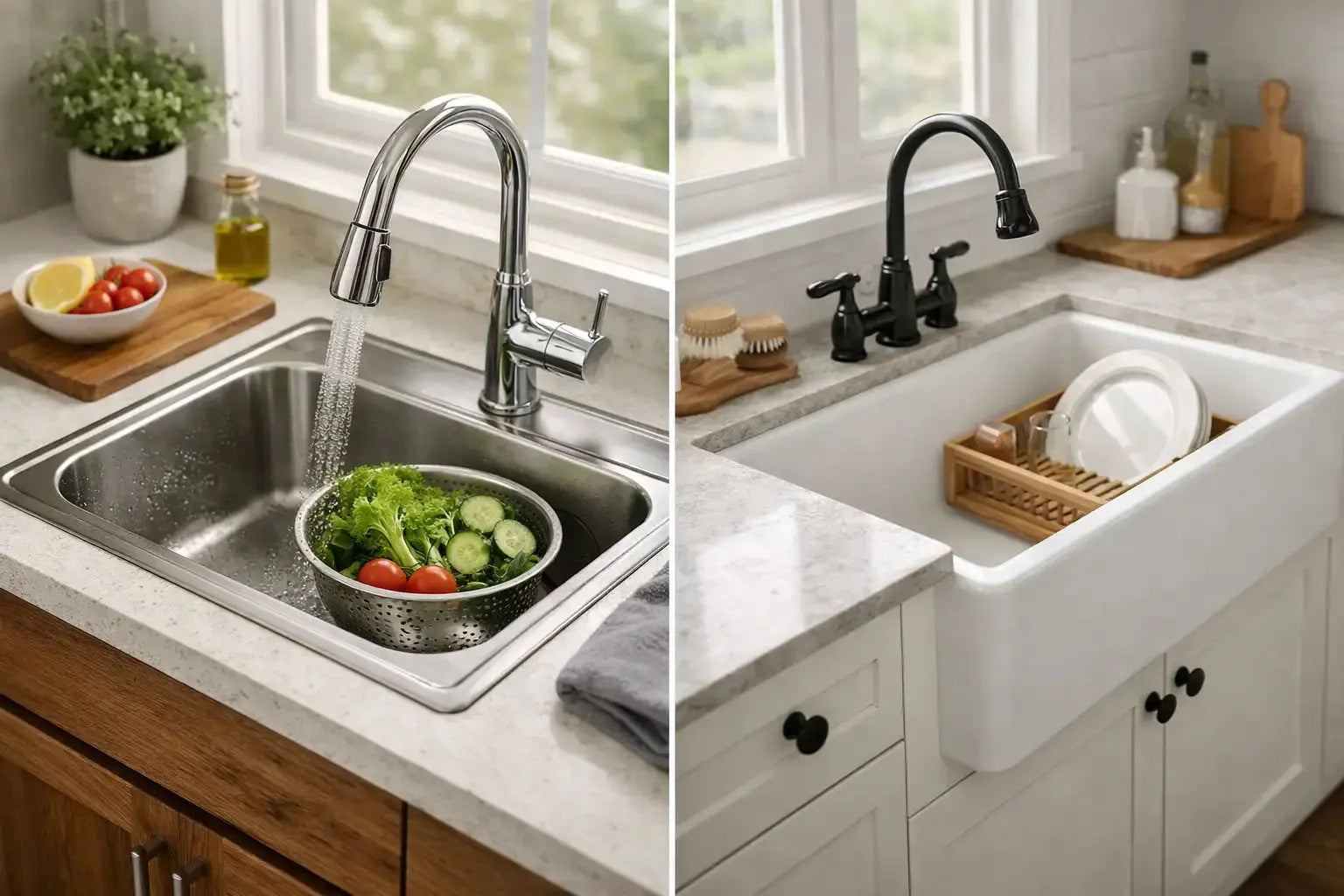
A kitchen sink choice can affect far more than the look of the counter. In a drop in sink vs farmhouse sink decision, the cabinet construction, countertop material, installation sequence, faucet layout, and everyday cleaning routine all matter. One option can often replace an existing sink with minimal disruption; the other may require a purpose-built cabinet but creates a stronger design statement.
The first distinction is worth making clear: a drop-in sink describes how the sink is installed, while a farmhouse sink describes its apron-front design. Many farmhouse models are undermount installations, but drop-in apron-front models also exist. Confirm the manufacturer’s installation instructions before selecting a sink based on appearance alone.
Drop In Sink vs Farmhouse Sink: The Core Difference
A drop-in sink, also called a top-mount or self-rimming sink, is lowered into a cutout in the countertop. Its rim sits on top of the counter and supports the sink. This installation works with many counter materials, including laminate, solid surface, stone, and wood, provided the cutout and cabinet meet the sink manufacturer’s requirements.
A farmhouse sink has an exposed front panel that extends to, or replaces, the front of the sink cabinet. It is typically deeper and wider-looking than a standard sink, although dimensions vary substantially. The apron creates the defining visual effect, while the installation arrangement determines the actual work involved.
For a straightforward kitchen refresh, a drop-in sink is usually the more flexible option. For a renovation where cabinetry and countertops are being replaced or modified, a farmhouse sink may be the better fit.
Installation and Cabinet Requirements
Installation is where the two sink styles begin to separate sharply.
Drop-in sinks work with more existing kitchens
A drop-in sink can be an efficient replacement when its overall dimensions and required cutout are compatible with the existing counter. The rim covers the edge of the cutout, which can help accommodate small variations in an older opening. That makes top-mount sinks practical for many replacement projects, particularly in laminate countertops where an undermount installation may not be suitable.
The cabinet still needs enough interior width, depth, and clearance for the bowl, clips, drain fittings, and water connections. A deep single-bowl sink can interfere with a garbage disposer, filtration system, pull-out waste bin, or stored items below. Measure the interior cabinet opening, not just the exterior cabinet width.
Farmhouse sinks need planned support
A farmhouse sink is not normally carried by the countertop alone. Its weight, especially in fireclay, cast iron, or natural stone, requires a reinforced cabinet base or a dedicated support frame. The cabinet front must be cut or built to accept the apron, and the countertop opening must align precisely with the sink edge.
This is manageable in a full renovation, but it can add labour and cost to a retrofit. Existing cabinet doors, false drawer fronts, and face frames may need alteration. If replacing an existing sink without changing the cabinet, verify whether an apron-front model is designed for retrofit use rather than assuming any farmhouse sink will fit.
Before ordering either style, compare the specification sheet against four measurements: cabinet interior width, cabinet depth, countertop cutout, and available clearance for plumbing below. Also account for the faucet, backsplash, and any window ledge behind the sink.
Style and Countertop Pairing
Drop-in sinks offer a wide range of finishes and configurations. Stainless steel remains a common choice for busy family kitchens and rental properties because it is familiar, durable, and available in many sizes. Granite composite provides a more matte, architectural look, while enamelled cast iron can bring colour and weight to a traditional kitchen.
Because the rim remains visible, select a finish that works with the countertop. A slim stainless rim can suit quartz or granite, while a thicker composite rim can look intentional against a textured or darker counter. The visible edge is also useful when the countertop cutout is not perfectly clean or when replacing a sink without replacing the counter.
Farmhouse sinks are often chosen for their visual presence. White fireclay is a classic pairing for Shaker cabinetry, warm woods, and transitional kitchens, while stainless steel apron-front models suit contemporary spaces. Dark composite and metallic finishes can create a more tailored, modern result.
The right choice depends on how prominent the sink should be. A drop-in sink can blend into the work surface. A farmhouse sink is designed to be seen from across the room.
Cleaning, Durability, and Daily Use
A farmhouse sink’s forward position is appreciated by many cooks because there is less countertop directly between the user and the bowl. This can feel more comfortable when washing large cookware. Its deep basin is also useful for stock pots, roasting pans, and baking sheets.
That depth has trade-offs. A very deep bowl may be less comfortable for shorter users, and its large interior can use more water if the basin is filled. A single large bowl is versatile for oversized cookware, while a divided sink can make rinsing and food preparation easier. Bowl configuration often has a greater effect on daily workflow than the installation style itself.
Drop-in sinks have a rim where crumbs and water can collect, so regular wiping around the edge is needed. The rim also breaks the continuous line between countertop and sink. Farmhouse and undermount installations reduce that countertop edge, making it easier to wipe debris into the bowl, but they still need careful cleaning around the sink-to-counter seal.
Material matters as much as form. Stainless steel handles heat well and resists corrosion, but can show water spots and scratch over time. Fireclay resists staining and has a smooth finish, but can chip if heavy cookware is dropped against it. Composite sinks are valued for their colour consistency and resistance to everyday wear, though manufacturers’ heat and cleaning guidance should always be followed.
Cost Beyond the Sink Price
Comparing ticket prices alone can be misleading. A drop-in sink may cost less to install because it can use an existing cabinet and counter opening. It may also reduce countertop fabrication costs in a replacement project.
A farmhouse sink can represent a larger total investment because of cabinet modifications, structural support, countertop templating, and installation labour. Heavy materials may require two installers and additional care during delivery and placement. If the project includes new cabinets and counters anyway, these costs can be incorporated into the renovation plan rather than treated as an unexpected upgrade.
Faucets and accessories should be budgeted at the same time. Check whether the sink has faucet holes, whether the faucet will mount on the counter or wall, and whether there is room for a soap dispenser, air switch, filtered-water tap, or side spray. A sink grid, basket strainer, and correctly sized drain assembly can also protect the basin and simplify maintenance.
Which Sink Is Right for Your Project?
Choose a drop-in sink when you are working with an existing countertop, want broad material compatibility, need a practical replacement, or prefer a lower-complexity installation. It is a strong choice for renovations where cabinet changes are not part of the scope.
Choose a farmhouse sink when the apron-front look is central to the kitchen design, the cabinet can be modified or built for it, and a deep, generous basin suits the way the kitchen will be used. It is particularly effective in new kitchens and larger renovations where cabinet, countertop, and plumbing decisions are coordinated early.
For contractors and homeowners alike, the most reliable purchase starts with the specification sheet rather than a photo. Plumbing Market offers sinks, faucets, drains, and installation components for kitchen renovations, making it easier to match the fixture to the cabinet and countertop plan.
If a fireclay farmhouse sink is on your list, see our Franke Manor House fireclay farmhouse sink guide, the Franke collection and the Kindred collection.
Bring cabinet measurements, counter details, and the preferred faucet configuration into the selection process before finalizing a sink. That small amount of planning can prevent a beautiful fixture from becoming an expensive cabinet alteration after delivery.


