

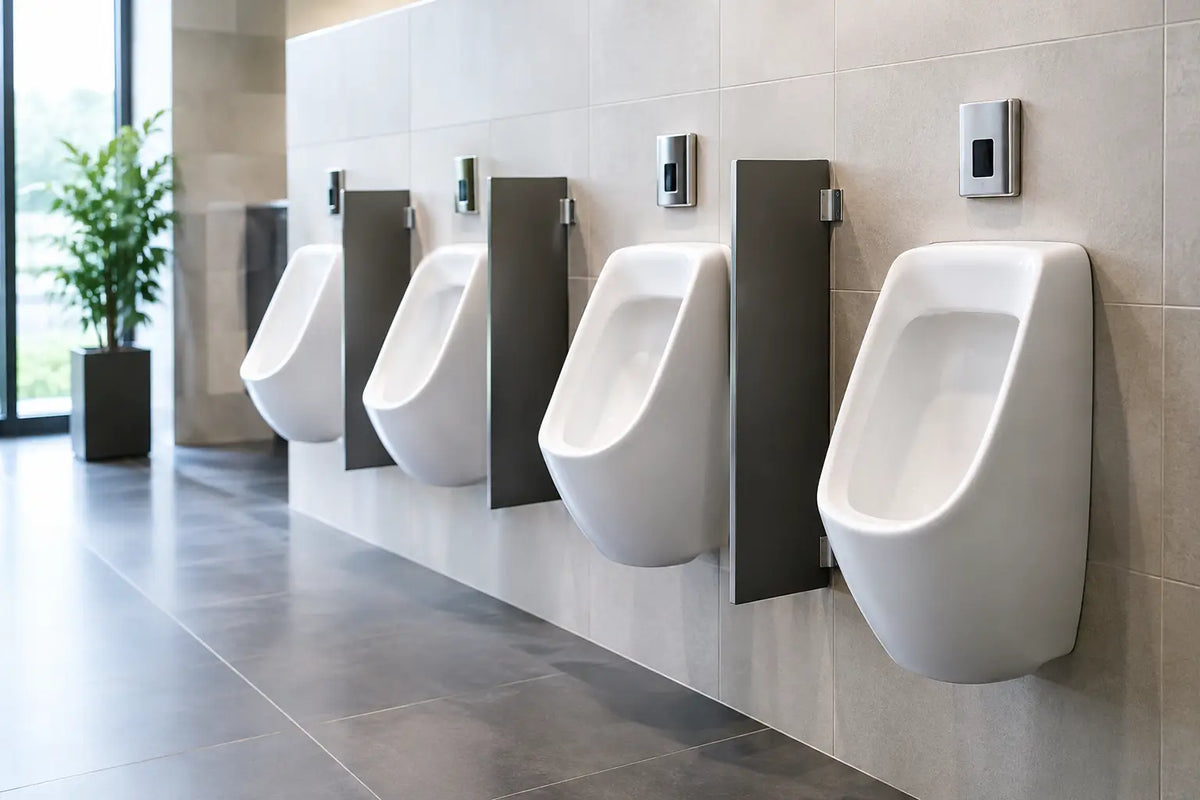
A urinal is a high-use commercial fixture, so the lowest purchase price is rarely the lowest long-term cost. Bowl geometry, flush volume, valve compatibility, water pressure, wall support and cleaning access all affect how the washroom performs after opening day. This urinal buying guide is designed for Canadian contractors, facility managers, renovators and property owners comparing fixtures for offices, restaurants, schools, retail spaces and multi-unit properties.
The right selection starts with the washroom plan and plumbing conditions, not with finish or price alone. Confirm the available rough-in, water supply, drainage location, accessibility requirements and expected daily traffic before narrowing down styles.
Start with the urinal type
Most commercial projects use wall-hung vitreous china urinals. They keep the floor clear, make mopping easier and suit the majority of new-build and renovation applications. A wall-hung fixture also gives installers flexibility in setting the mounting height, subject to the fixture specification and applicable accessibility requirements.
Floor-mounted urinals are less common but remain useful where wall structure, existing drain placement or heavy-duty applications make them the practical choice. They can be easier to support in certain retrofit conditions, although their footprint requires more floor cleaning and can limit layout options in compact washrooms.
Trough urinals are intended for high-traffic environments such as sports facilities, arenas and industrial settings. They serve several users at once and can be efficient where throughput matters more than privacy. However, they require careful planning for drainage, flushing, privacy screens and local code acceptance.
Waterless urinals are another category to consider when water conservation is the priority or when supplying flush water is difficult. They use a cartridge or sealing liquid to control odours rather than a conventional flush. The trade-off is maintenance discipline: cartridges, sealant and cleaning products must be selected and replaced according to the manufacturer’s instructions. A waterless model is not a fit-and-forget fixture.
Choose the flushing system before ordering
The bowl and flushing system must work together. A conventional urinal may be paired with an exposed manual flush valve, a concealed flush valve, a sensor-operated flushometer or, in some settings, a tank-fed flushing arrangement. Each approach has a different balance of cost, serviceability and appearance.
Exposed flushometers are a familiar choice for commercial washrooms because service components are accessible and replacement parts are widely understood by plumbing professionals. They suit utility-focused spaces, schools, restaurants and facilities where fast maintenance matters. Their visible pipework creates a more traditional commercial look.
Concealed flush valves place the operating components behind the wall, producing a cleaner appearance and reducing exposed hardware. They are often selected for design-led offices, hospitality spaces and premium public washrooms. Before specifying one, confirm access-panel requirements and ensure the valve body is compatible with the planned wall assembly.
Manual handles are straightforward and reliable, but touchless operation can improve hygiene and help reduce unnecessary contact points. Sensor flush valves need dependable power, either through batteries, hardwiring or a hybrid system. Battery-powered models simplify installation where electrical work is impractical, while hardwired systems reduce battery replacement in high-use facilities. Sensor settings also need to be appropriate for the environment, as poor calibration can lead to double flushing or missed activations.
Do not assume every flush valve will suit every site. Supply pressure, pipe sizing, valve flow rating and fixture performance requirements must be checked together. A flushometer that performs well in one building may not operate correctly on another building’s water supply.
Water use is a performance decision
Urinals are commonly available in low-flow configurations, with flush volumes ranging from ultra-low-flow options to higher-volume commercial models. Lower water use can reduce operating costs and support sustainability targets, particularly in busy facilities. It also needs to provide adequate bowl rinse and drain-line performance for the selected fixture and installation.
A very low-flow urinal is often an excellent choice, but it depends on the washroom’s usage pattern, drain configuration and maintenance program. Infrequently used washrooms may require additional attention to trap seals, odour control and cleaning routines. For existing buildings, a plumber should assess whether the current supply and drainage conditions support the proposed fixture and valve combination.
When comparing products, look beyond a single water-consumption figure. Review the complete specification: approved flush valve pairing, trap configuration, inlet location, drain outlet, required pressure range and recommended cleaning procedure. These details prevent expensive substitutions later in the project.
Size the fixture and plan the layout
Urinal projection, width and rim height determine how the fixture fits within a washroom. A compact bowl can preserve circulation in a small commercial restroom, while a larger elongated unit may offer better splash control and user comfort in a high-traffic setting. The dimensions on a product page should be treated as planning information, but final clearances should be verified against drawings and local requirements.
Privacy is equally important. Partitions between urinals can improve user comfort and help control splash outside the fixture zone. Their depth and location should allow for cleaning access without interfering with doors, accessible routes or neighbouring fixtures.
For accessible washrooms, mounting heights, clear floor space, controls and approach requirements vary by jurisdiction and project type. Confirm the requirements that apply to the province, municipality and building classification before installation. A fixture may be marketed for commercial use without being suitable for every accessible layout.
Confirm rough-in and wall support details
Rough-in errors are among the most costly urinal installation problems. Before placing an order, verify the waste outlet location, water inlet height, centreline dimensions, carrier requirements and finished-wall thickness. Never rely on a previous fixture’s rough-in unless its specification matches the replacement exactly.
Wall-hung urinals typically require a properly rated carrier or support system behind the finished wall. The carrier must be selected for the fixture weight and installed as part of the wall framing and plumbing rough-in. A decorative wall surface does not provide the structural support required for a commercial bowl.
Also consider service access. Concealed valves, batteries, sensors and control modules may need an access panel. Planning this early is far easier than cutting into finished tile or millwork after commissioning.
Select materials and finishes for the cleaning routine
Vitreous china remains the standard material for most urinal bowls. It is durable, non-porous and familiar to cleaning teams. White is the most common colour because it makes residue, damage and cleaning results easy to see, although other finishes may be available for coordinated commercial design schemes.
The valve finish should match the environment. Chrome is widely used, durable and easy to coordinate with other commercial washroom fittings. In high-abuse locations, prioritize proven commercial-grade components and readily available replacement parts over decorative details.
Cleaning procedures deserve attention at the purchasing stage. Harsh chemicals, abrasive pads and incompatible cleaners can damage surfaces, sensors, cartridges or valve components. Facility teams should receive the fixture care instructions along with the product documentation, especially when specifying waterless systems or electronic controls.
Compare total ownership cost, not only fixture price
A complete urinal purchase may include the bowl, flush valve, carrier, inlet spud, stop valve, sensors, batteries, partitions and installation hardware. Some products are sold as bowls only, while others are packaged with compatible flushing components. Comparing incomplete packages can make one option look less expensive than it will be once the full installation is priced.
For commercial buyers, replacement-part availability should carry real weight. Diaphragms, handles, sensor modules, cartridges and repair kits are normal service items over the life of a washroom. Established commercial brands and clearly specified components can reduce downtime when maintenance is needed years later.
Before ordering, confirm these project details with the installer and product specifications:
- fixture type, bowl dimensions and planned mounting height
- waste, water inlet and carrier rough-in measurements
- compatible flush valve, power source and available water pressure
- applicable plumbing, accessibility and building requirements
- access requirements for future valve, sensor or cartridge service


