

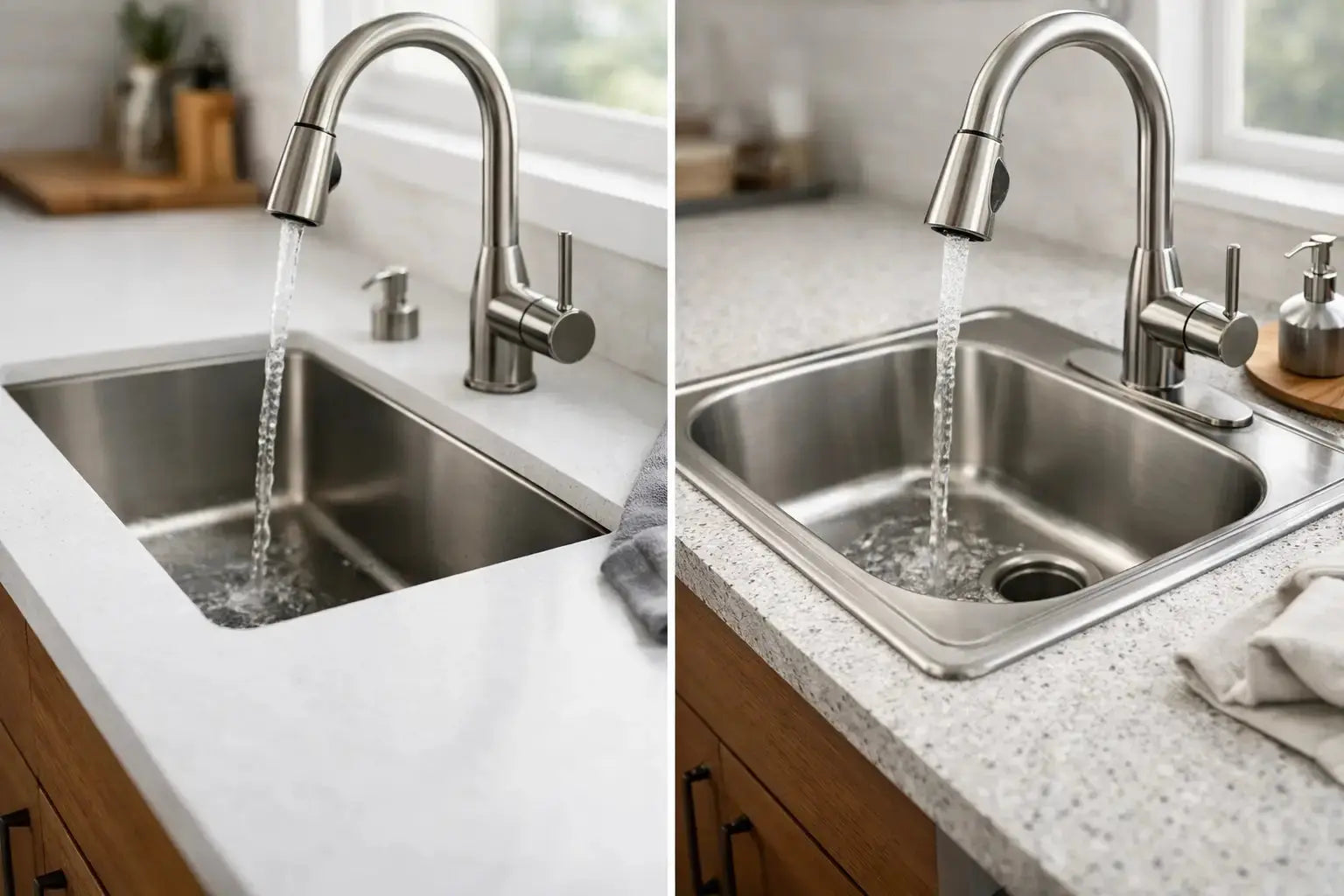
A sink replacement can change more than the look of a kitchen or bathroom. It affects countertop fabrication, cabinet clearance, cleaning routines, faucet placement, and installation cost. In an undermount sink vs drop in decision, the right choice usually comes down to the countertop you have, the look you want, and whether the project is a simple replacement or a full renovation.
An undermount sink is attached below the countertop, leaving the counter edge exposed around the bowl. A drop-in sink, also called a top-mount or self-rimming sink, sits in a cutout with its rim resting on top of the counter. Both designs are widely available in stainless steel, granite composite, cast iron, fireclay, vitreous china, and other materials. Neither is automatically better. Each serves a different installation and ownership priority.
Undermount Sink vs Drop In: The Main Difference
The visible rim is the quickest way to tell these sink types apart. A drop-in model has a finished lip that overlaps the countertop. Its weight is largely supported by that lip and the cabinet structure below. Caulk or silicone seals the perimeter to keep water from reaching the cutout.
An undermount sink is installed from below. It is held in place with mounting clips, brackets, rails, or adhesive systems specified by the sink and countertop manufacturer. The countertop opening must be accurately fabricated because the cut edge remains visible. Depending on the desired reveal, the countertop may sit slightly over the sink edge, align with it, or stop just short of it.
That construction difference affects almost every buying consideration, from compatible counter materials to long-term maintenance.
Cleaning and Everyday Use
For busy kitchens, the undermount design has a clear practical advantage. Crumbs, water, and food scraps can be swept directly from the counter into the sink without catching on a rim. This is especially useful beside a main prep sink, on a large island, or in households that cook often.
There is also no raised lip around an undermount sink to collect residue. The transition between sink and counter still needs regular cleaning, particularly at the silicone joint, but the overall counter surface is easier to wipe down.
Drop-in sinks have a rim that interrupts that sweep-in motion. Water can sit along the edge, and the seam below the rim should be cleaned to prevent staining or mildew. This is rarely a deal-breaker in a bathroom vanity, laundry room, bar, or secondary kitchen, where the sink sees less food preparation. For many practical installations, the small cleaning trade-off is acceptable given the simpler fitting process.
Countertop Compatibility Matters Most
Countertop material often decides the issue before style does. Undermount sinks need a strong, stable, water-resistant countertop edge. They are typically paired with granite, quartz, marble, soapstone, concrete, solid surface, and other slab materials. These surfaces can support the sink and provide a finished cutout edge when properly fabricated.
Laminate countertops are generally a poor match for conventional undermount installation. The exposed particleboard core can absorb moisture and swell if the edge is not fully protected. Some specialized undermount solutions exist for laminate, but they require a purpose-built system and careful fabrication. They are not interchangeable with a standard undermount sink installation.
Drop-in sinks work with nearly every common counter material, including laminate. The rim covers the rough cutout edge, protecting it from routine splashes and allowing more flexibility in sizing. This makes a top-mount sink a practical choice when retaining an existing laminate counter or replacing an older sink without rebuilding the surrounding work surface.
Natural stone also deserves special consideration. A heavy cast iron, granite composite, or fireclay undermount sink may need additional support beyond standard clips. Confirm the weight, cabinet configuration, and mounting method before the countertop is templated. A fabricator and installer should work from the sink's actual specification sheet, not from a rough product dimension.
Installation Cost and Renovation Scope
Drop-in sinks are usually faster and less costly to install. In many replacement projects, a new model can fit an existing opening or require only modest adjustment. The installer lowers the sink into place, checks the fit, applies sealant, secures the clips where applicable, and reconnects the drain and faucet.
Undermount sinks require more coordination. The sink is normally installed before or during countertop fitting, and the opening must be cut to match the selected reveal. If the counter is already installed, replacing an undermount sink can be difficult because access is restricted and the existing stone cutout cannot easily be changed.
For a full kitchen renovation with new quartz or granite, the additional planning for an undermount sink is often worthwhile. For a quick sink replacement on a serviceable laminate counter, a drop-in option can avoid the cost of new countertops and fabrication.
Do not overlook faucet and accessory clearances. A deeper bowl may affect disposal, trap, and shutoff-valve space inside the cabinet. A workstation sink with ledges, grids, colanders, or cutting boards can require a wider cabinet than a standard single bowl. Measure the cabinet interior, not only the countertop opening.
Design Options for Kitchens and Bathrooms
Undermount sinks create a clean, built-in appearance that suits modern, transitional, and high-end kitchen designs. With the countertop running uninterrupted to the bowl, the sink feels integrated rather than added on. This is a strong choice for minimalist kitchens, large stone islands, and vanity tops where the countertop material is a design feature.
Drop-in sinks offer more visual variety than many buyers expect. Stainless steel models are common for utility-focused kitchens and laundry rooms, while enamelled cast iron and granite composite options can provide colour and a substantial rim detail. A drop-in bar sink or prep sink can also be an efficient way to add functionality to an existing counter.
In bathrooms, both formats work well. Undermount bathroom sinks make vanity cleanup easier and keep attention on the countertop and faucet. Drop-in bathroom sinks are useful where a visible rim suits the vanity style, where the counter is laminate, or where installation needs to stay straightforward. Vessel sinks are a separate category and should not be confused with either option, as they sit above the counter and require different faucet and drain planning.
Durability, Sealing, and Long-Term Service
A properly installed undermount sink is durable, but the installation quality is critical. The adhesive and support system must be rated for the sink's material and weight. The silicone joint between countertop and sink should remain intact to prevent water from reaching the cabinet below. If that joint fails, it should be removed, cleaned, and resealed promptly.
Drop-in sinks also depend on a sound seal, but their rim offers an extra layer of protection over the cutout. They are often easier to remove for repairs or replacement. This can matter in rental properties, commercial break rooms, or homes where a practical future upgrade path is more valuable than a concealed mounting style.
Material selection changes maintenance as well. Stainless steel resists impact and is widely used in kitchens. Granite composite provides a matte, stone-like finish but benefits from regular cleaning to prevent mineral buildup. Fireclay and cast iron offer a classic look but are heavier and may need cabinet reinforcement. Match the material to how the sink will be used, not only to its finish.
How to Choose the Right Sink Type
Choose an undermount sink when you are installing a new stone, quartz, solid-surface, or similarly suitable countertop and want the easiest possible counter cleanup. It is particularly effective for primary kitchen sinks where prep space and a refined built-in appearance are priorities.
Choose a drop-in sink when you are working with laminate, replacing an existing sink, controlling installation costs, or fitting out a laundry, utility, bar, or commercial support area. It is also a sensible option when future replacement access matters.
Before ordering, confirm the minimum cabinet width, overall sink dimensions, bowl depth, drain location, required countertop cutout, and faucet-hole configuration. For an undermount model, verify the recommended reveal and mounting requirements with the countertop fabricator. For a drop-in model, measure the existing opening from below and above the counter, since an overlapping rim can hide an opening that is larger than expected.
Plumbing Market carries kitchen and bathroom sink options alongside faucets, drains, grids, strainers, mounting components, and replacement parts, making it easier to match the fixture to the rest of the installation. Start with the countertop and cabinet constraints, then select the sink style that gives the finished space the right balance of performance, serviceability, and design.


