

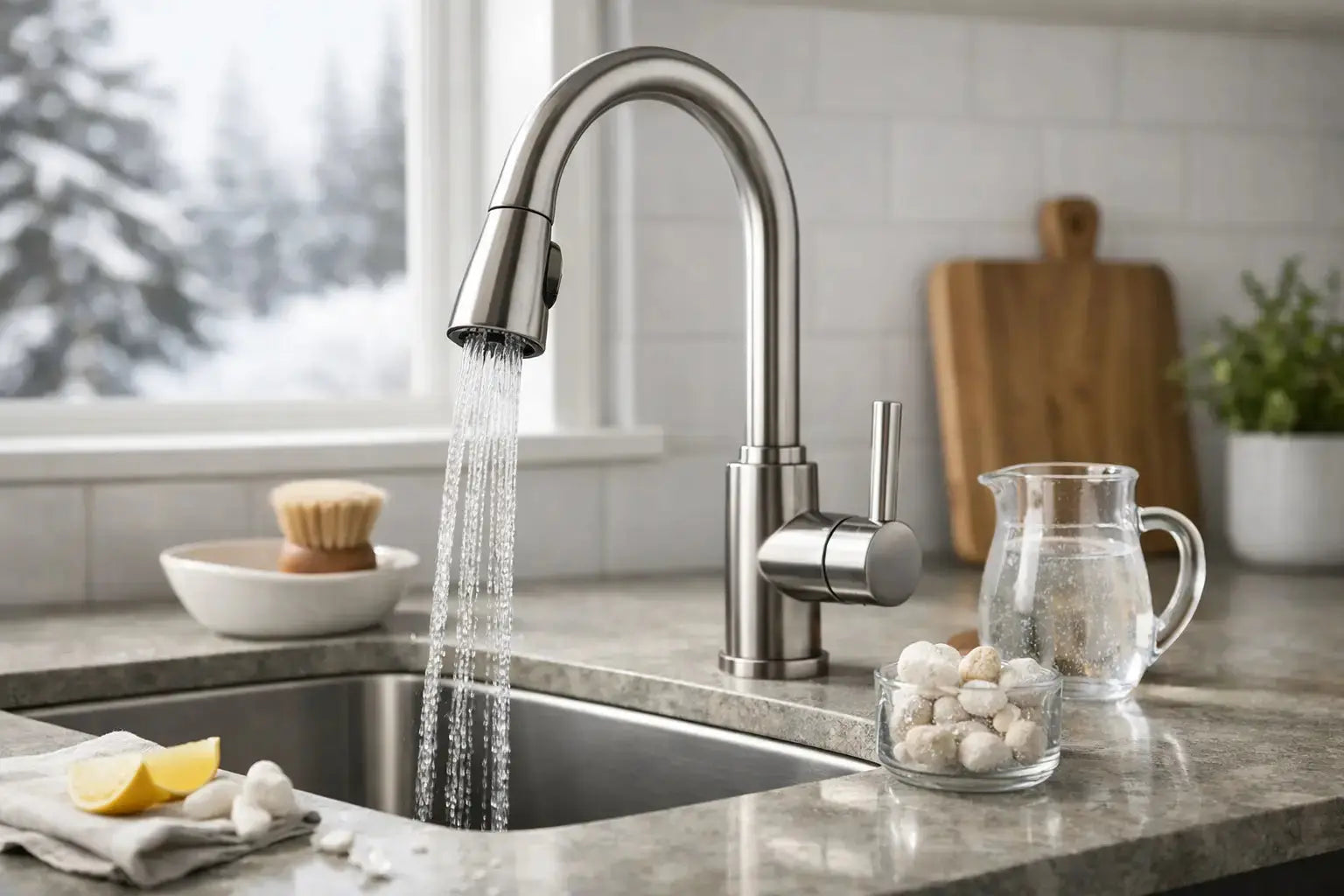
Hard-water spotting can make a new kitchen faucet look tired far sooner than it should. The best kitchen faucets for hard water are not simply the most expensive models or the ones with the shiniest finish. They are faucets with durable internal components, a finish that is practical to clean, accessible aerators, and a configuration that suits the way your household uses the sink.
For Canadian homeowners and renovators, water hardness can vary considerably by municipality, building age, and whether the property uses municipal water or a well. A faucet that performs well in a low-mineral area may require much more frequent care in a hard-water home. Selecting the right fixture at the start can reduce mineral buildup, preserve water flow, and make everyday cleaning less frustrating.
What Hard Water Does to a Kitchen Faucet
Hard water contains dissolved minerals, primarily calcium and magnesium. When droplets dry on the faucet body, they leave white or chalky deposits. These deposits are most visible on darker finishes and highly reflective chrome, but they can appear on any finish over time.
The more consequential issue is what happens inside the faucet. Minerals can collect in the aerator, reducing or distorting the stream. They can also affect a pull-down spray head, spray selector, check valves, and other small waterway components. If the spray pattern becomes uneven or the flow noticeably weakens, an obstructed aerator or spray head is often the first place to investigate.
Hard water does not automatically rule out a particular faucet style or finish. It does mean that details such as serviceability, spray-head design, and replacement-part availability deserve more attention than they might in a soft-water area.
Best Kitchen Faucets for Hard Water: The Right Types
There is no single faucet that suits every kitchen. The strongest choice depends on whether cleaning convenience, heavy-duty performance, filtered drinking water, or a particular design direction is the priority. These four configurations are especially practical for hard-water households.
Pull-Down Faucets With Easy-Clean Spray Heads
For most residential kitchens, a single-handle pull-down faucet is the most balanced option. It provides a high arc for pots and pans, a flexible spray head for rinsing, and one-handed temperature control. In a hard-water home, look closely at the spray nozzles.
Many premium kitchen faucets use soft silicone or rubber spray nozzles that allow mineral deposits to be rubbed away with a finger or soft cloth. This is more convenient than trying to clear buildup from a conventional perforated spray face. A pull-down model also makes it easier to inspect the spray head when flow changes.
Choose a model with a smooth hose retraction system and a secure docking mechanism. These features are not directly related to water hardness, but they matter for long-term daily use and reduce the risk of a spray head hanging loose or wearing unevenly.
Pull-Out Faucets for Compact Sinks
A pull-out faucet has a shorter spout and a spray head that pulls outward rather than down. It can be an excellent fit for smaller kitchens, shallow upper cabinets, or sinks located beneath a window. Because the spout profile is lower, there are fewer high surfaces where water can sit and dry.
This style is not necessarily easier to maintain than a pull-down faucet, but it offers practical reach in compact layouts. Prioritize a model with an accessible aerator and a spray face designed for simple cleaning. If the kitchen sees frequent dishwashing or food preparation, test the hose reach and spray controls against the size of the sink before making a final selection.
Commercial-Style Semi-Professional Faucets
For larger sinks, serious home cooks, and light commercial applications, a semi-professional kitchen faucet can be a strong hard-water choice. These models typically have a flexible spring coil, a higher spout, and a powerful spray pattern for rinsing cookware and cleaning the sink bowl.
The trade-off is surface area. Spring coils, exposed hose sections, and detailed spray heads can collect visible mineral residue if they are not wiped regularly. Select a model with a finish suitable for frequent cleaning and avoid overly intricate details if low maintenance is the main objective. A commercial-style faucet is a performance upgrade, not a maintenance-free one.
Filtered Water Faucets Paired With a Main Faucet
A dedicated filtered water faucet does not remove hardness from the entire kitchen faucet system unless it is connected to a treatment system designed to do so. However, it can be a useful addition where drinking-water taste, odour, or mineral content is a concern.
Pairing a standard main faucet with a separate filtered water dispenser keeps filtered drinking water distinct from regular hot and cold water. This arrangement can also reduce wear on the main faucet when household members repeatedly fill bottles, kettles, and coffee makers. For hard water specifically, confirm what the chosen filtration or treatment system is designed to reduce. Standard carbon filters and water softeners address different water-quality concerns.
Materials and Finishes That Make Maintenance Easier
The faucet finish changes how visible water spotting will be, but appearance is only one part of the decision. The quality of the base construction and protective finish matters more than choosing a colour alone.
Stainless steel and brushed nickel are often practical choices for hard-water households because their softer, brushed appearance can make everyday spotting less obvious than a high-polish surface. Chrome remains a popular, durable option with broad design compatibility, but dried mineral marks can be more noticeable because of its reflective finish.
Matte black, brushed gold, and other designer finishes can work well in hard-water areas, particularly in a design-led renovation. They simply require a more disciplined cleaning routine. Do not use abrasive pads, powder cleansers, or harsh chemicals unless the manufacturer specifically permits them. These products can damage the finish before hard water does.
Beyond the visible finish, look for a ceramic disc cartridge. This is the standard worth seeking in a quality kitchen faucet because ceramic discs offer smooth handle operation and dependable shutoff. They are not immune to debris or mineral contamination, but they are generally a better long-term choice than older compression-style mechanisms.
Features Worth Comparing Before You Buy
When comparing kitchen faucets, product photos alone do not reveal the details that matter most in a hard-water home. Review the specifications for the aerator type, spray-head maintenance, cartridge design, mounting requirements, and warranty coverage.
An aerator that can be removed with a standard key or simple tool is easier to clean than one requiring a proprietary procedure. Some faucets use recessed or hidden aerators for a cleaner appearance. These can look excellent, but make sure the required service tool is included and replacement aerators are available.
Also consider the number of mounting holes in the sink or countertop. A single-hole faucet creates a clean look and is common in contemporary kitchens. If replacing a three-hole faucet, a matching deck plate may be needed to cover the unused openings. This is a straightforward detail, but overlooking it can delay installation.
Touchless and touch-activated faucets offer convenience when hands are messy, but they add electronic components, batteries or an AC adapter, and more installation considerations. They can be worthwhile in busy households, but a conventional single-handle faucet remains the simplest option for buyers who prioritize easy future servicing.
How to Maintain a Faucet in a Hard-Water Home
The most effective maintenance is brief and frequent. Wipe the faucet dry after heavy use, especially around the base, spout, handle, and spray head. A soft microfiber cloth is usually sufficient. This prevents droplets from evaporating into visible deposits.
When mineral buildup appears, use a mild cleaner approved for the faucet finish. For removable aerators, soaking the part in a suitable descaling solution can restore flow, but follow the manufacturer instructions and avoid exposing vulnerable finishes or non-metal components to products that are not recommended.
If the spray head has flexible nozzles, gently rub them during regular cleaning to dislodge surface minerals. If flow remains poor after cleaning the aerator and spray face, inspect the supply lines and shutoff valves, then consider whether sediment is entering the fixture from the plumbing system. Homes supplied by wells may benefit from professional water testing before choosing a broader filtration or softening solution.
Choosing a Faucet That Fits the Kitchen and the Water
A hard-water kitchen needs a faucet that is attractive, serviceable, and realistic for the household's cleaning habits. A brushed pull-down faucet with an easy-clean spray head is often the most practical all-purpose choice. A semi-professional model suits larger work zones, while a dedicated filtered water faucet can complement a main fixture where drinking-water treatment is part of the plan.
Before ordering, measure the sink, check clearance to upper cabinets or windows, confirm the mounting-hole configuration, and verify that replacement parts are available for the selected model. Plumbing Market offers kitchen faucet options across trusted brands and configurations, making it easier to match the fixture to both the renovation design and the technical requirements of the installation.
A faucet should not become the kitchen's most demanding cleaning task. Select one with accessible service parts and a finish you are willing to maintain, then give it a quick wipe after use. That small routine will do more to protect its appearance than chasing a supposedly hard-water-proof finish.


