

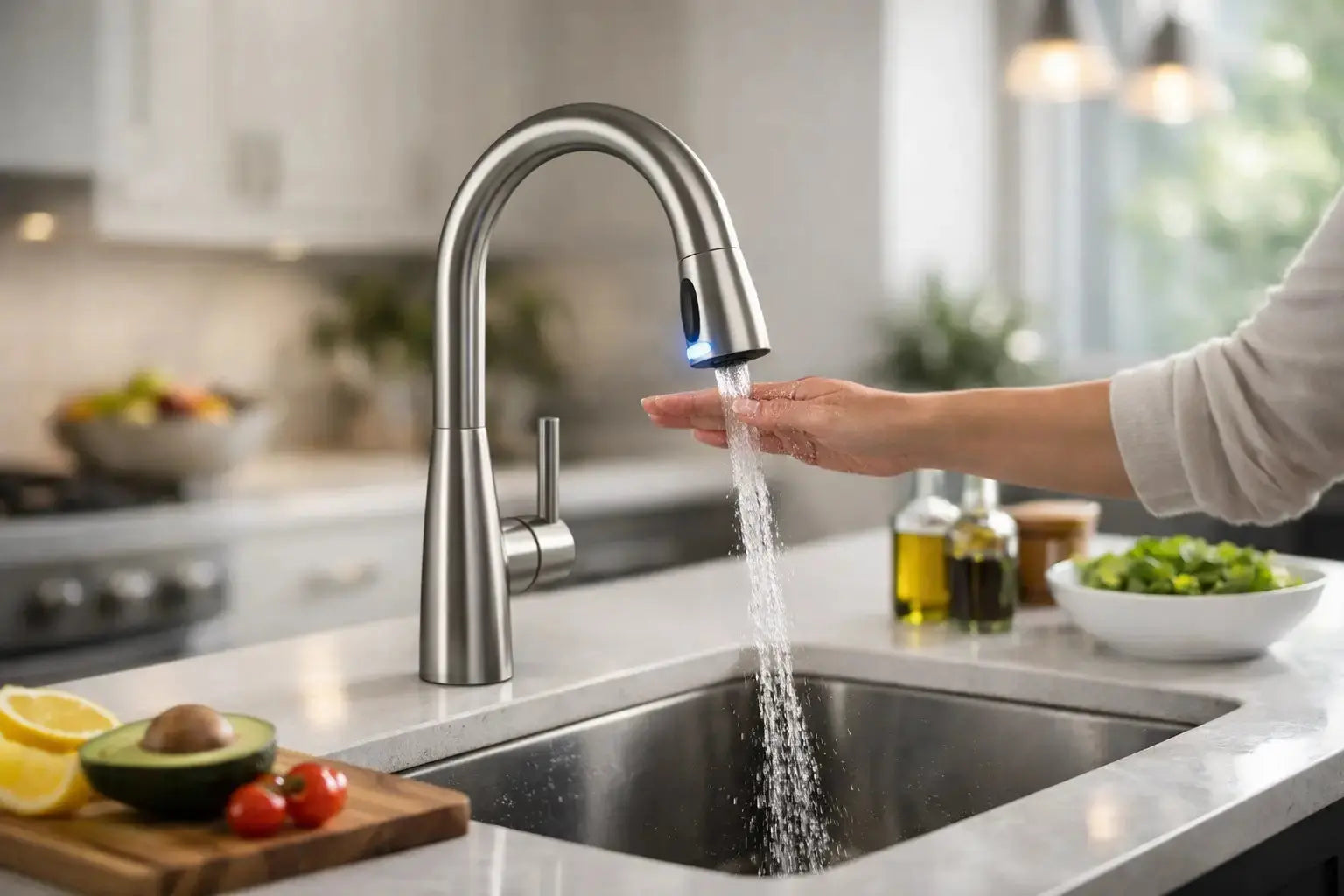
A raw chicken prep station, a full stockpot in one hand, or a toddler asking for water are the moments when a touchless faucet earns its place. But are touchless kitchen faucets worth it for every kitchen renovation? Not automatically. They add genuine convenience and can reduce mess on the fixture, yet they also introduce electronics, power requirements, and a higher purchase price than a standard manual kitchen faucet.
For homeowners planning a long-term upgrade, busy family kitchens and accessibility-focused spaces, the advantages can be substantial. For a simple rental refresh, a low-use secondary sink, or a kitchen where straightforward repairability is the priority, a quality manual faucet may be the better buy.
Are Touchless Kitchen Faucets Worth It? The Short Answer
A touchless kitchen faucet is worth considering when hands-free operation solves a real daily problem. Its sensor starts the water flow when it detects a hand, dish, or object in the activation area, allowing users to wash, rinse, and fill containers without gripping the handle. Most models retain a manual handle to set temperature and flow, so the sensor controls on-off operation rather than replacing all adjustment.
The value is strongest in high-traffic kitchens. Households that cook frequently, wash produce, manage young children, or use the sink throughout the day will notice the difference more than someone who mainly uses a kitchen for coffee and occasional meals. It can also be a practical feature for people with limited hand mobility or arthritis.
The trade-off is simple: the faucet is no longer only a mechanical fixture. It is a mechanical fixture with a sensor, solenoid, control box, and power source. Choosing a reputable brand, confirming the cabinet space below the sink, and understanding the power arrangement are part of a successful purchase.
Where a Touchless Faucet Delivers Real Value
Cleaner operation during food prep
A conventional faucet handle is a frequent contact point. When hands are covered in flour, dough, raw meat residue, or cooking oil, turning water on can transfer grime to the handle. A touchless model reduces that contact. It does not make a kitchen sterile, and regular cleaning remains necessary, but it can make food preparation tidier and reduce repeated wiping of the faucet body.
This benefit is especially useful with pull-down kitchen faucets. You can activate the water, rinse the sink or produce, and use the spray head without repeatedly reaching for a lever. For households that prepare meals daily, this is convenience that is felt rather than merely advertised.
Better workflow when hands are full
Hands-free activation helps with awkward tasks: filling a pot, rinsing a cutting board, washing a baby bottle, or cleaning up while holding a dish. Some faucets offer an automatic shutoff after a set period. That feature helps prevent water from running indefinitely if someone walks away or the sensor is activated unintentionally.
The time savings on any one task are small. Over a week, however, the reduced handling can make the sink feel easier to use. This is why touchless technology often makes more sense as part of a full kitchen renovation than as a purely cosmetic replacement.
Accessibility without changing the kitchen look
Lever handles are already easier to operate than knobs, but a motion sensor can reduce the need for wrist strength, grip, or precise hand movement. For aging-in-place renovations and multi-generational homes, that can be a meaningful functional upgrade.
Many sensor faucets are available in the same design categories as premium manual models, including transitional, contemporary, and traditional styles. A homeowner does not necessarily have to choose between accessible operation and a finish that suits the cabinetry, hardware, and sink.
The Costs and Limitations to Consider
Touchless faucets typically cost more than comparable manual faucets because of the electronic components. The initial price difference is only part of the equation. Buyers should also factor in batteries or an AC adapter, the potential need for an outlet in the sink cabinet, and eventual replacement components such as a solenoid or sensor module.
Battery-powered models are often the easiest option for an existing kitchen because they do not require electrical work. Battery life varies by model and household use, so it is wise to keep the correct replacements available. An AC-powered setup avoids battery changes but may require planning during renovation, particularly if there is no protected outlet under the sink.
Sensor behaviour is another consideration. Good models are designed to avoid accidental activation, but any sensor can be triggered by a nearby object, a reflective surface, or movement in a tight sink area. Placement matters. A very shallow sink, a crowded counter edge, or storage directly below the control box can affect day-to-day satisfaction.
There is also a maintenance reality. A standard faucet can often be repaired with a cartridge, aerator, or hose replacement. A touchless faucet may require diagnosis of both plumbing and electronic parts. Selecting a recognized manufacturer with accessible replacement parts can make future service far easier for a homeowner, plumber, or facility maintenance team.
What to Check Before Buying
A touchless kitchen faucet should be chosen as carefully as any other working kitchen fixture. Start with the sink configuration. Confirm the number of mounting holes, the deck thickness, and whether an escutcheon plate is needed to cover unused holes. Check the faucet's spout height and reach against the depth of the sink and the clearance below upper cabinets or a window.
Then look below the sink. The control box, battery pack, or power adapter needs secure, accessible space away from cleaning products and items that may snag hoses. If the cabinet is already tight because of a garbage disposal, water filtration system, or pull-out waste bin, measure first. Installation can be straightforward, but a crowded cabinet is a common source of frustration.
Water supply and local installation practices also deserve attention. Confirm that the faucet is suitable for Canadian plumbing connections and that the included supply lines, adapters, and mounting hardware match the project requirements. If an outlet will be installed beneath the sink, it should be planned and completed appropriately before the faucet is fitted.
For a renovation, consider the sink, faucet, soap dispenser, filtration tap, and accessories as one work zone. A tall pull-down sensor faucet may look impressive, but it needs enough room to operate without interfering with a backsplash shelf, window trim, or pendant lighting reflection.
Touchless vs. Touch-Activated vs. Manual Faucets
These categories solve slightly different problems. A touchless faucet uses a motion sensor, so no physical contact is needed to start or stop water. A touch-activated faucet turns on when you tap the spout or handle area with a hand, wrist, or forearm. It still reduces mess during cooking but requires a deliberate touch.
Manual faucets remain the simplest and often the most economical choice. They have fewer components, broad style selection, and familiar maintenance needs. A high-quality single-handle pull-down faucet is still an excellent fit for many homes, particularly where the kitchen is used lightly or where the budget is directed toward a sink, countertop, or cabinetry.
For commercial or shared environments, touchless operation can offer a different kind of value. It can reduce contact between users and support easier cleaning routines, although the fixture should be selected for the expected duty cycle and service requirements. Residential kitchen models are not automatically the right choice for every commercial sink application.
Choosing the Right Touchless Faucet
Prioritize proven construction and serviceability over novelty. Look for a durable finish appropriate to the kitchen, a pull-down or pull-out spray function if it suits the sink, clear manual override capability, and readily available replacement parts. Check whether the model uses batteries, AC power, or both, and confirm the warranty terms for electronic components as well as the faucet finish and mechanical parts.
Finish should be practical as well as decorative. Chrome is easy to coordinate and often forgiving to maintain. Stainless and brushed finishes can suit contemporary kitchens, while matte black and warmer metallic finishes can create a stronger design statement but may show mineral spotting or fingerprints differently depending on the water quality and finish.
A touchless faucet is most valuable when it makes the kitchen easier to use every day, not when it is added solely because it is a smart feature. Measure the sink area, plan the under-sink space, and choose a model with parts support that matches the expected life of the renovation. That approach gives the upgrade a much better chance of feeling useful long after the new-kitchen excitement has passed.


