

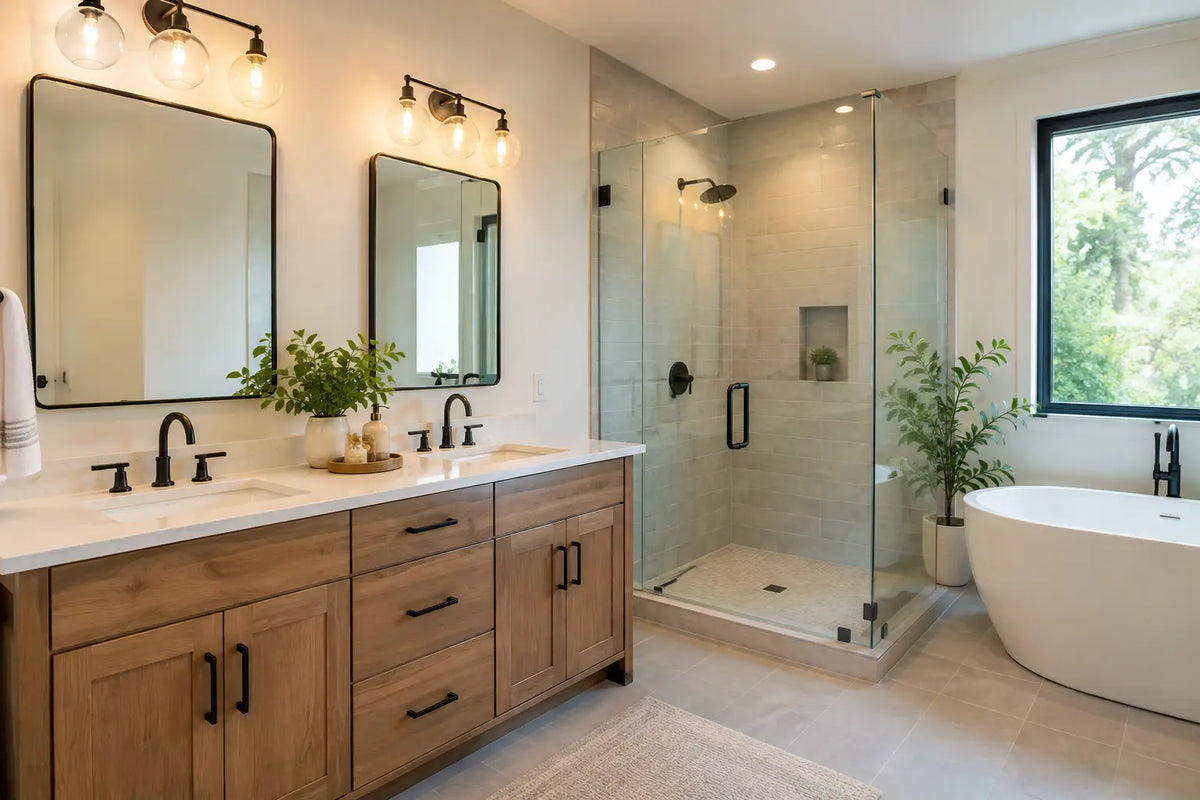
A bathroom can have an excellent vanity, tile, faucet, and shower system yet still feel unfinished under a single ceiling fixture. Current bathroom lighting trends are moving away from one-source illumination and toward considered layers that make daily routines easier while giving the room a more finished appearance. For Canadian renovations, the right choice also needs to suit the room size, ceiling height, moisture exposure, and the electrical requirements of the installation.
The strongest lighting plans are practical first. They provide clear, even light at the mirror, comfortable ambient light for the full room, and focused illumination where it is genuinely useful. Design follows naturally when each fixture has a defined role.
Bathroom Lighting Trends That Work in Real Homes
Layered light replaces the single vanity bar
The most useful shift is layered lighting. Rather than relying on one fixture above the mirror, homeowners are combining ambient, task, and accent lighting. A ceiling-mounted fixture, recessed lights, or a compact flush mount supplies general visibility. Vanity lights handle grooming tasks. Accent fixtures, such as a small decorative pendant or a wall sconce near a freestanding tub, add depth where the layout allows it.
This approach matters most in bathrooms with dark tile, deep wall colours, or limited natural light. It also gives users more control. Bright task lighting may be needed in the morning, while lower ambient lighting is more comfortable for a late-night visit.
Layering does not mean filling every ceiling and wall with fixtures. In a compact powder room, a well-sized vanity light and one ceiling fixture can be enough. Larger ensuites often benefit from separate circuits or dimmers so the light level can change without compromising visibility.
Vertical sconces improve mirror lighting
Sconces placed on both sides of the mirror remain one of the most practical choices in bathroom lighting. Their appeal is not just decorative. Light that comes from the sides of the face reduces the shadows created by a fixture mounted only above the mirror. That makes shaving, makeup application, skincare, and contact lens use more comfortable.
A pair of slim sconces can suit a modern floating vanity, while more detailed glass shades work well with transitional or traditional cabinetry. The proportion is critical. Narrow fixtures are often better beside a single vanity, while a wide double vanity may need substantial sconces, a linear fixture, or a combination of both.
Placement depends on the mirror, backsplash, and available wall space. The goal is to centre the light around face height for the intended user, but exact dimensions should be confirmed with an electrician and adjusted to the vanity layout. Avoid selecting fixtures before finalizing mirror size and medicine cabinet depth. A surface-mounted cabinet can leave too little clearance for side lighting if this is overlooked.
Backlit mirrors add clean task light
Integrated LED mirrors and backlit medicine cabinets are popular because they reduce visual clutter. They provide an even halo of light, suit contemporary bathrooms, and can be especially effective in smaller spaces where a conventional fixture would compete with the mirror.
The trade-off is that not all backlit mirrors provide enough forward-facing light for close grooming. Some create a pleasant ambient glow but still need a ceiling fixture or a dedicated vanity light. Buyers should review the product's light output, colour temperature, control method, and whether the LED components are serviceable or designed as an integrated unit.
Defogging features, touch controls, and integrated outlets can be useful upgrades, particularly in busy family bathrooms. They should not replace a sound lighting plan. A mirror with advanced features still needs appropriate electrical planning and a suitable location outside prohibited wet zones.
Warm Metals and Softer Light Are Setting the Tone
Bathroom finishes are becoming more coordinated. Matte black remains a strong option, particularly with black shower frames and faucets, but warmer finishes are increasingly common. Brushed nickel, champagne bronze, brushed gold, and mixed-metal combinations help make a bathroom feel less stark than an all-chrome scheme.
A lighting fixture does not need to match the faucet exactly. Coordinating undertones is usually more successful than forcing an exact finish match. For example, a brushed brass sconce can work with a champagne bronze faucet when the overall palette includes warm tile, oak, or beige stone. Polished chrome can still be the right choice for a crisp, classic bath, especially when paired with white ceramic fixtures and cooler grey finishes.
Colour temperature is equally influential. Many homeowners now prefer warm white light in the 2700K to 3000K range because it flatters skin tones and feels comfortable in the evening. For a highly functional vanity, 3000K is often a practical middle ground: warm enough for residential comfort but clear enough for everyday tasks.
Very cool lighting can make white tile look bluish and can create an overly clinical effect. On the other hand, excessively warm light may alter how makeup, clothing, or paint colours appear. The best choice depends on the bathroom's natural light, finish palette, and how the space is used.
Decorative fixtures are moving beyond the ceiling
Bathrooms are increasingly treated as finished rooms rather than utility spaces. This has created demand for decorative flush mounts, compact semi-flush fixtures, and carefully selected pendants. A pendant over a freestanding tub can create a focal point, but it is not appropriate in every bathroom. Ceiling height, clearance, and electrical safety requirements must guide the decision.
For low ceilings, a quality flush mount can provide a cleaner result than a pendant that crowds the room. In a narrow bathroom, an oversized fixture may interfere with sightlines and make the space feel smaller. Decorative lighting should be selected after the major fixtures, not before them. The tub profile, vanity width, mirror shape, shower glass, and hardware finishes all affect what will look proportionate.
Smart Controls Make Lighting More Useful
Smart lighting is gaining traction, though the most valuable upgrade is often the simplest: a dimmer. Dimming lets one fixture serve multiple purposes, from bright morning grooming to a softer evening setting. It can also help extend bulb life when compatible lamps and controls are used.
Occupancy sensors and motion-activated night lighting are practical for powder rooms, children's bathrooms, and guest bathrooms. In a primary ensuite, a low-level toe-kick LED strip or under-vanity light can offer safer navigation without turning on overhead lights. This is a subtle addition that has a noticeable effect on daily use.
Smart switches can provide scheduling, scene control, and app-based operation, but they require compatible wiring and products. They are most useful when the bathroom has multiple lighting layers. A single fixture in a small bathroom may not justify a complicated control system. For renovations, confirm neutral-wire requirements, dimmer compatibility, and whether smart controls will work with the selected LED fixtures before purchase.
Choose Fixtures for Moisture, Maintenance, and Installation
Bathrooms are demanding environments. Steam, splashes, cleaning products, and frequent temperature changes all affect fixture selection. Decorative style matters, but safety ratings and installation location come first. Fixtures used near a shower, tub, or wet area may need a specific wet-location rating, while other bathroom locations may require damp-location suitability.
LED lighting is now the standard choice for efficiency and longevity, but replacement options vary. Fixtures with replaceable bulbs are straightforward to maintain and make it easier to adjust colour temperature later. Integrated LED fixtures can offer a slim profile and uniform light, but buyers should consider warranty coverage and the future replacement process.
Glass selection also affects maintenance. Clear glass delivers strong light and exposes decorative bulbs, but it shows dust and water spots more readily. Frosted or opal glass softens glare and can be easier to live with in a high-use family bathroom. Open-bottom shades can simplify bulb changes, while enclosed fixtures may better suit a cleaner, more tailored look.
For contractors and renovators, fixture specifications should be reviewed alongside the electrical rough-in plan. Confirm junction box locations, vanity width, mirror dimensions, ceiling joist constraints, and switching before walls are closed. This reduces the risk of moving boxes, patching tile, or settling for a compromised fixture position later.
Build the Lighting Plan Around the Vanity First
The vanity is where lighting has the greatest daily impact, so it is the best starting point. Establish the vanity width, sink configuration, faucet style, mirror or medicine cabinet, and backsplash height. Then choose task lighting that delivers even illumination without creating glare on the mirror.
From there, add ambient lighting appropriate to the room's size and natural daylight. If the bathroom includes a water closet, shower niche, or tub zone that feels visually separate, consider whether a small accent light would improve function or atmosphere. Keep the plan disciplined. Every fixture should earn its place through better visibility, better control, or a stronger finished look.
Plumbing Market customers can coordinate bathroom lighting with vanities, mirrors, faucets, shower systems, and accessories while keeping product dimensions and finishes aligned across the renovation. Start with the tasks the room must support, then select lighting that makes those tasks easier every day.


