

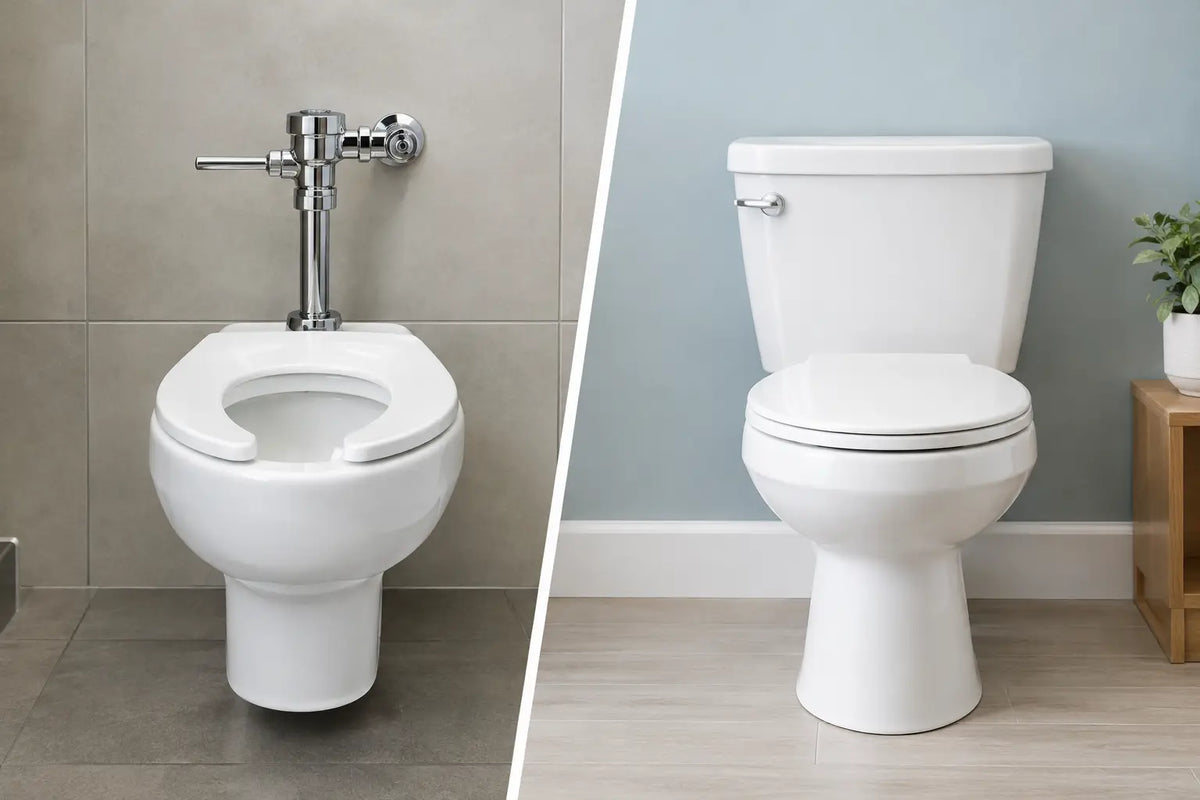
A toilet decision can affect far more than the appearance of a finished washroom. It determines the required water supply, rough-in planning, maintenance approach, operating noise, and long-term replacement options. When comparing flushometer vs tank toilets, the right choice usually comes down to building type: tank toilets suit most homes, while flushometer systems are built for high-traffic commercial use.
Flushometer vs Tank Toilets: The Core Difference
A tank toilet stores a measured amount of water in a tank mounted behind the bowl. When the handle, button, or sensor is activated, a flush valve releases that stored water into the bowl. Afterward, the fill valve refills the tank for the next use. This is the familiar configuration in houses, condominiums, apartments, and many small offices.
A flushometer toilet has no tank. Instead, it uses a flushometer valve connected directly to the building's pressurized water line. Pressing a handle or activating an electronic sensor opens the valve briefly, delivering a controlled flush volume directly to the fixture. Flushometer valves are common in public washrooms, restaurants, schools, airports, offices, and other facilities where toilets are used repeatedly throughout the day.
The visual difference is immediate. A tank toilet is a self-contained fixture with a visible tank, while a flushometer installation typically has an exposed chrome valve above the bowl. Concealed flushometer systems are also available where a cleaner, more architectural finish is required.
Why Tank Toilets Are Usually the Residential Choice
For a typical Canadian bathroom renovation, a tank toilet is the practical default. It is designed to operate on standard residential plumbing conditions and does not depend on the high flow rate required by a flushometer valve. The tank stores the flush water before use, so the fixture can perform reliably even where supply pressure or pipe sizing would not support a commercial valve.
Tank toilets also offer the broadest range of residential styles. Homeowners can choose one-piece toilets, two-piece toilets, wall-hung models with concealed tanks, compact elongated bowls, chair-height seating, skirted bases, and smart toilet configurations. This flexibility matters when a project balances comfort, cleaning access, layout constraints, and design preferences.
Replacement parts are familiar to most plumbers and experienced homeowners. Common service items include flappers, fill valves, flush valves, trip levers, tank-to-bowl gaskets, and supply hoses. A worn component can often be replaced without removing the toilet from the floor.
Tank toilets are not identical, however. Flush performance depends on bowl design, trapway geometry, flush valve size, and the fixture's rated water consumption. A quality 4.8 LPF or 6 LPF toilet can provide dependable performance while reducing water use compared with older high-volume models. For a renovation, selecting a recognized brand with readily available replacement parts is often as important as choosing the bowl shape or finish.
Where a Tank Toilet Has Limits
The main limitation is recovery time. Once flushed, the tank must refill before another full flush is available. In a household, this is rarely a concern. In a busy restaurant washroom or school facility, it can become one. A tank toilet also occupies more visual and physical space behind the bowl, although compact and concealed-tank options can reduce that impact.
Why Flushometer Toilets Dominate Commercial Washrooms
Flushometer toilets are designed for frequency, durability, and controlled performance in demanding environments. Because they connect directly to the water supply, they are ready for the next user immediately after a flush cycle. There is no tank refill delay and no tank lid or internal tank assembly to service.
For commercial buyers, the appeal is operational. A properly specified flushometer valve can handle continuous use, while exposed valve bodies provide straightforward access for maintenance staff and plumbers. Parts such as diaphragms, pistons, handles, vacuum breakers, control stops, and solenoids can be serviced without replacing the toilet bowl.
Flushometer systems are also available with manual, battery-powered, hardwired, and sensor-operated controls. Sensor flushometers can support touch-free washroom design, which is often preferred in public facilities, healthcare settings, and high-traffic office buildings. The appropriate control type depends on the available electrical infrastructure, maintenance policy, and user environment.
Commercial fixtures must be matched carefully. A flushometer bowl is not simply a standard tank toilet bowl with the tank removed. It is engineered for valve-delivered water volume and flush velocity. The valve and bowl must be compatible in flush volume, inlet configuration, and installation dimensions.
Water Supply Requirements Matter
A flushometer installation needs more than a cold-water line behind the toilet. It requires adequate dynamic pressure and pipe capacity to deliver the necessary flow during the flush. This is why flushometers are usually installed in commercial buildings with plumbing systems designed around their demand.
Trying to install a standard flushometer in a typical detached home can lead to weak flushing, pressure drops at nearby fixtures, noise, or inconsistent operation. Upsizing piping may be possible during a major renovation or new build, but it adds cost and must be planned by a qualified plumbing professional. Building code requirements, local water conditions, and fixture approvals should all be reviewed before specifying the system.
Installation, Maintenance, and Operating Cost
Tank toilets are generally less expensive to purchase and install in residential settings. The plumbing connection is simple: a shutoff valve, supply line, floor flange, and standard rough-in dimension. Most floor-mounted models use a 12-inch rough-in, though 10-inch and 14-inch configurations are available for specific layouts.
A flushometer installation involves more planning. The supply line, valve rough-in, bowl spud connection, wall clearance, and control-stop location all need to align. For exposed systems, installers also need to account for the valve's visible dimensions and service clearance. Concealed systems require access panels and coordination with wall construction before finishes are installed.
Maintenance follows a different pattern. Tank toilets often need occasional internal part replacement due to mineral buildup, leaking flappers, or aging fill valves. A running tank toilet can waste a meaningful amount of water if not repaired promptly. Flushometers have fewer moving components visible to the user, but their internal kits and sensors require correct specification and periodic service, especially in hard-water areas or facilities with heavy use.
Water efficiency is not automatically determined by the presence of a tank. Both configurations can meet modern low-flow requirements. The key is to select a toilet and valve rated for the desired flush volume, then ensure the installation supports that rating. A 4.8 LPF tank toilet may be an excellent residential option, while a commercial flushometer bowl and valve may be specified at 4.8 LPF, 6 LPF, or another approved volume based on the application and local requirements.
Choosing the Right Toilet for the Space
Choose a tank toilet when outfitting a house, condo, apartment, cottage, ensuite, or small private office. It offers a wider range of residential designs, works with typical plumbing infrastructure, and makes future servicing straightforward. One-piece and skirted models are particularly appealing where easy cleaning and a refined appearance are priorities.
Choose a flushometer toilet when the washroom will see regular, high-volume public use and the building has the pressure and supply capacity to support it. It is a strong fit for retail spaces, restaurants, schools, institutional buildings, multi-user office washrooms, and other commercial projects where rapid reset and durable serviceability matter.
For smaller commercial spaces, do not assume a flushometer is mandatory. A well-specified tank toilet may be appropriate where traffic is limited, water supply is constrained, or the project requires a more residential aesthetic. Conversely, a residential-style toilet may not be the best choice for a busy public washroom simply because it costs less upfront.
Before ordering, confirm the rough-in, bowl type, water-supply conditions, flush volume, accessibility needs, and whether the fixture will be residential or commercial grade. Plumbing Market's range of toilets, flushometer valves, repair parts, and commercial washroom components makes it easier to source compatible products for the complete installation.
The best toilet is the one that matches the building's plumbing capacity and the number of people who will use it. Get those two details right before choosing the style, and the finished washroom will be easier to maintain, more reliable in daily use, and better suited to the project.


