

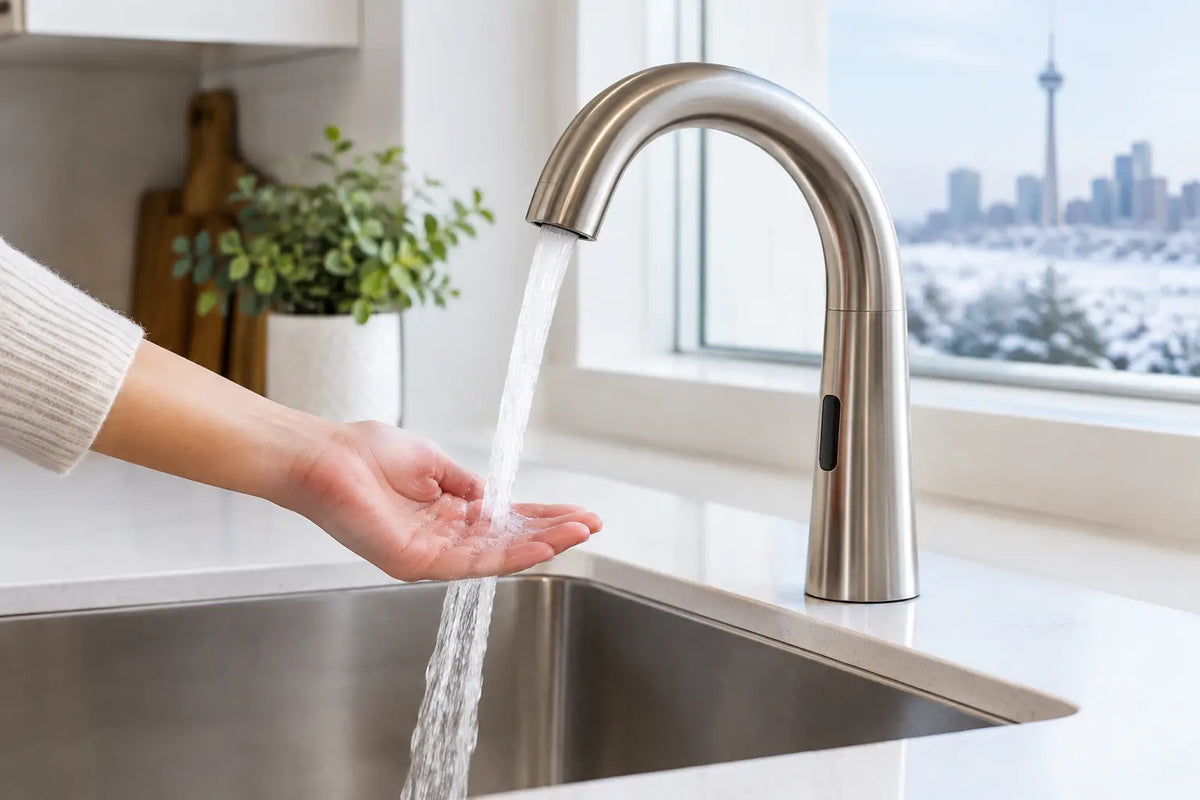
A faucet that turns on when hands are covered in flour, paint, soap, or raw-food residue solves a real daily problem. This touchless faucet review focuses on what Canadian homeowners, renovators, contractors, and facility buyers should assess before choosing a sensor-operated fixture for a kitchen, bathroom, or commercial washroom.
Touchless models are no longer limited to airports and public facilities. They are now available in residential bathroom configurations, kitchen faucets with pull-down sprayers, and commercial deck-mounted and wall-mounted designs. The right choice depends less on the novelty of hands-free operation and more on sensor performance, power requirements, installation conditions, and access to replacement parts.
What a Touchless Faucet Does Well
A touchless faucet uses an infrared sensor, capacitive sensor, or proximity-based control to activate water flow without operating a handle. Most models still include a manual lever for temperature adjustment, while others use a preset mixing valve to deliver water at a controlled temperature.
The main advantage is cleaner operation. In a kitchen, users can start the water without transferring food residue to the handle. In a powder room or shared bathroom, fewer hand contacts can reduce visible smudges and make routine cleaning easier. For commercial washrooms, automatic shutoff helps limit unnecessary water use when a user walks away.
There are practical limits. A poorly positioned sensor can activate when someone passes nearby, while a low-cost sensor may respond slowly or inconsistently. Touchless operation also does not replace a good faucet layout. Spout reach, clearance above the sink, spray function, and flow rate still determine whether the fixture works well in daily use.
Touchless Faucet Review: The Features That Matter
The best touchless faucet is not always the one with the most electronic settings. Reliable essentials generally matter more than app control or decorative extras, especially in a high-use kitchen or commercial washroom.
Sensor range and response time
Sensor performance should be the first consideration. A good sensor activates promptly when hands enter the intended zone and shuts off predictably after they move away. In bathroom applications, the activation area is usually directly below the spout. Kitchen faucets need a more carefully tuned sensor because dishes, utensils, and sink activity can enter the range frequently.
Some kitchen models use a wave sensor at the side of the faucet body. Others use a sensor near the spout base or a touch-activation system. A wave sensor can be convenient when hands are dirty, but placement is critical. If the sensor faces a busy prep area, false activation may become frustrating.
For commercial applications, a fixed infrared sensor with an adjustable detection range is often the most practical option. Facility managers should prioritize consistent operation and easy servicing over consumer-style features.
Power source and battery access
Touchless faucets are commonly powered by replaceable batteries, an AC adapter, or a combination of both. Battery-powered units are often simpler to install because they do not require a nearby electrical outlet. They are particularly useful in retrofit projects where opening a wall or cabinet to add power is not practical.
The trade-off is maintenance. Battery life varies with usage, water temperature, sensor settings, and the battery type specified by the manufacturer. A residential bathroom faucet may run for a long period between changes, while a busy commercial washroom can require more frequent attention. Check where the battery pack will sit and confirm it can be reached easily after the vanity and plumbing are in place.
AC-powered faucets remove the routine of battery replacement but may increase installation scope. In commercial settings, hardwired power can make sense when the washroom is being built or fully renovated. For any powered installation near water, use an appropriate protected electrical connection and follow local electrical requirements.
Temperature control and safety
A touchless faucet manages water flow, but it may not manage temperature automatically. Many residential models have a manual side handle that lets users set the mix before using the sensor. This arrangement suits kitchens and bathrooms where occupants want quick access to hot or cold water.
Commercial faucets are often paired with a thermostatic mixing valve or mechanical mixing valve under the counter. This allows the faucet to provide a stable, pre-set temperature while reducing the risk of scalding. It is especially relevant in schools, healthcare environments, multi-unit properties, and public washrooms.
If the faucet will serve children, seniors, or the public, confirm how hot water is controlled at the fixture. A sensor should never be treated as a substitute for proper temperature regulation.
Kitchen and Bathroom Models Have Different Priorities
A touchless kitchen faucet should function as a full kitchen tool. Look for adequate spout height, a useful pull-down or pull-out spray head where needed, smooth hose retraction, and controls that remain accessible when the electronics are off. A dual-function spray pattern can be more valuable than advanced connectivity for most households.
Kitchen finishes should also be chosen with realistic maintenance in mind. Matte black, chrome, stainless, brushed nickel, and warm metallic finishes each create a different look, but they respond differently to fingerprints, hard-water marks, and cleaning products. Match the finish to cabinet hardware and sink material, then confirm the manufacturer-approved cleaning method before installation.
Bathroom touchless faucets are usually more compact and more straightforward. Spout height and reach must fit the basin, particularly with vessel sinks and shallow vanity tops. A short spout on a large vessel can send water too close to the drain or create splashing. Conversely, an oversized high-arc faucet can be awkward over a standard undermount basin.
For residential bathrooms, a manual handle is often worth having even when the faucet is sensor-operated. It provides direct control for tasks such as filling a container, adjusting water temperature, or using the fixture during a power-related issue.
Installation Checks Before You Order
Touchless faucet installation involves more than matching the number of mounting holes. Before selecting a model, measure the sink deck, backsplash clearance, faucet-centre position, and available space beneath the counter. The control box, solenoid, battery pack, and supply lines all need room inside the vanity or kitchen cabinet.
Verify the faucet's hole requirement. Some models install through a single hole, while others use a separate control handle or require a deck plate for three-hole sink configurations. If replacing an existing faucet, confirm whether the old hole spacing can be covered cleanly.
Water pressure is another consideration. Most quality faucets operate within a specified pressure range, but low pressure, blocked supply stops, or debris in the lines can affect performance. During a renovation, flush the supply lines before connecting the electronic control unit. Small particles can interfere with valves and sensors from the start.
A qualified plumber is a sensible choice for installations involving new shutoff valves, mixing valves, electrical connections, or commercial code requirements. For straightforward residential replacements, experienced DIY renovators can often complete the work if they follow the product instructions and have clear access below the sink.
Maintenance and Long-Term Serviceability
A touchless faucet has more components than a standard manual model, so long-term ownership should be part of the buying decision. The basic items that may eventually require attention include batteries, solenoids, sensors, aerators, spray hoses, cartridges, and control boxes.
Choose a recognized brand with clear documentation and available replacement components. This is especially important for contractors and commercial buyers who cannot afford to replace an entire fixture because a service part is unavailable. Plumbing Market carries both finished fixtures and specialized plumbing components, which can simplify sourcing when a renovation requires matching faucet hardware, valves, supply lines, and repair parts.
Routine care is uncomplicated. Wipe the finish with a soft cloth, avoid abrasive cleaners, and clean the aerator when flow begins to weaken. If a sensor starts behaving irregularly, replace batteries first where applicable, then check for a dirty sensor window, loose cable connection, or restricted water supply.
Is a Touchless Faucet Worth Buying?
For busy kitchens, shared bathrooms, and commercial washrooms, a well-selected touchless faucet can be a worthwhile upgrade. It improves convenience, supports cleaner fixture surfaces, and can reduce waste caused by faucets left running. The value is strongest when the sensor is reliable and the faucet still performs well as a conventional plumbing fixture.
It may not be the best choice for every project. A budget-focused renovation, a remote installation with difficult battery access, or a space with inconsistent water pressure may be better served by a quality manual faucet. Likewise, a decorative bathroom where the faucet sees little use may not justify the additional electronic components.
Start with the sink layout and how the space is actually used, then select the sensor type, power setup, finish, and service parts support that fit the project. A faucet that is easy to reach, easy to maintain, and properly sized for the basin will remain the better purchase long after the hands-free feature stops feeling new.


