

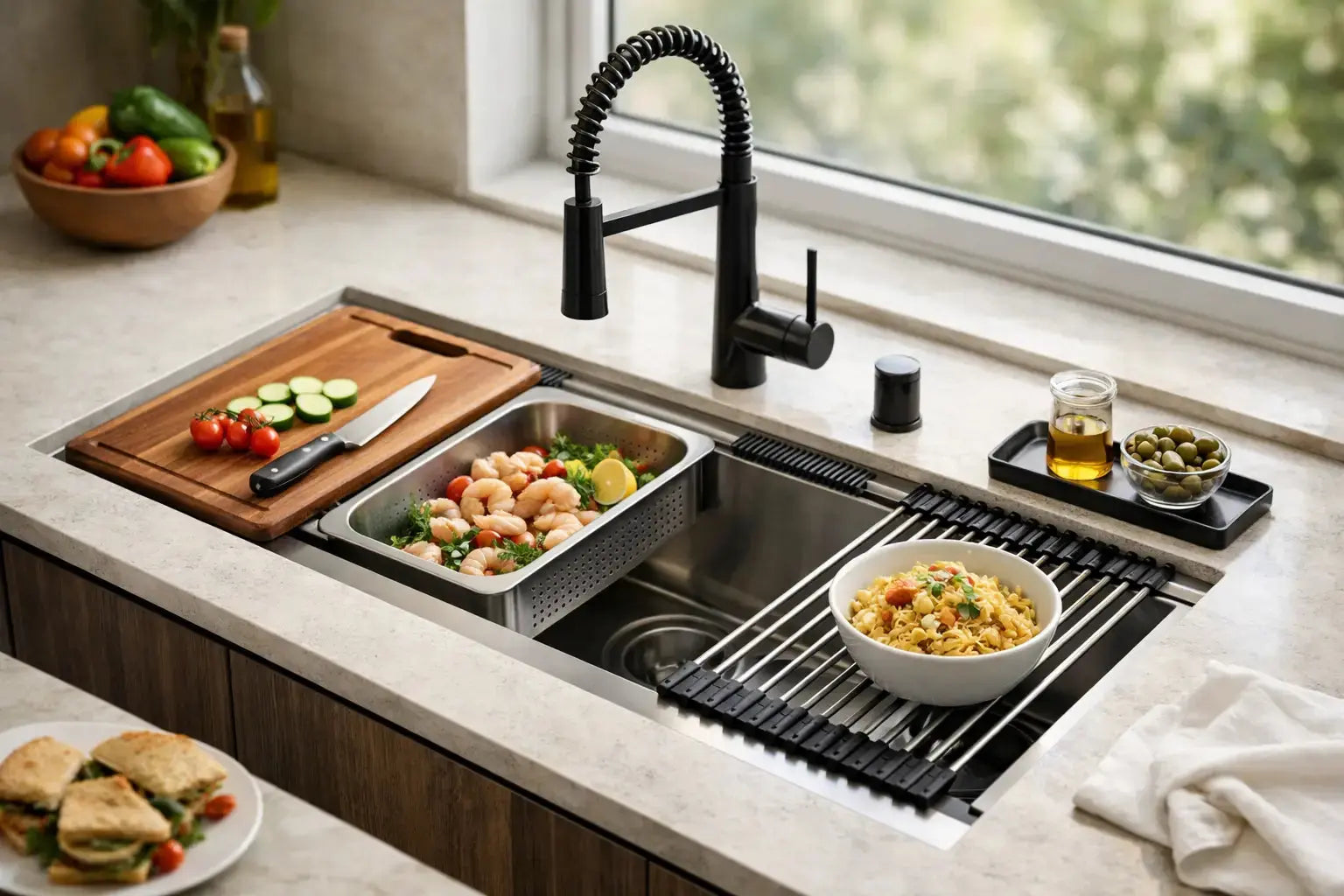
A busy kitchen counter disappears quickly: a cutting board lands beside the sink, a colander needs a place to drain, and produce is waiting to be washed. That is the appeal behind the question, are workstation sinks worth it? For many Canadian homeowners, they are - provided the sink size, cabinet layout, and day-to-day cooking habits support the investment.
A workstation sink is more than a deep basin. It has integrated ledges below the rim that hold fitted accessories, commonly a cutting board and colander, with some models also offering drying racks, prep bowls, grids, and serving trays. The accessories slide across the sink rather than taking up counter space. That can make a standard kitchen layout work harder, but it also introduces sizing, cleaning, and installation considerations that should be settled before ordering.
What Makes a Workstation Sink Different?
The defining feature is the internal track system. Unlike a conventional drop-in or undermount kitchen sink, a workstation model has one or two tiers of built-in ledges. These support accessories directly over the bowl, allowing washing, chopping, straining, and drying to happen in one contained area.
Most workstation sinks are single-bowl designs because one large basin gives the accessories enough usable surface. They are often made from stainless steel, although granite composite options are available for homeowners looking for a different finish or colour. Stainless steel remains a practical choice for high-use kitchens because it is durable, heat-resistant, and easy to coordinate with a broad range of kitchen faucets and appliances.
The feature set varies significantly by model. A basic package may include a bottom grid, a bamboo board, and a stainless steel colander. More complete packages can include roll-up drying racks, mixing bowls, prep boards, and multiple sliding accessories. The included accessories matter, but so does whether replacement pieces are available later. A workstation sink should be selected as a complete system, not simply as a basin with extra items in the box.
Are Workstation Sinks Worth It for Small Kitchens?
They can be especially worthwhile in a compact kitchen, condo, basement suite, or secondary prep area where uninterrupted counter space is limited. By moving food preparation over the bowl, the sink can free up a meaningful section of countertop. The roll-up rack also gives dishes a place to air-dry without covering the counter with a separate draining board.
That benefit is real only when the sink is proportioned properly. A very large workstation sink can overwhelm a narrow counter or leave insufficient space on either side for hot cookware, groceries, and plating. In a small kitchen, measure the available cabinet width and the surrounding work surface before choosing the largest bowl possible.
The same principle applies to sink depth. Deep bowls reduce splashing and handle large pots well, but a depth of 10 inches or more may be less comfortable for shorter users or for anyone who spends long periods washing dishes. Kitchen ergonomics are personal. If possible, compare the working height created by the cabinet, countertop, sink depth, and faucet before committing to a deep single-bowl model.
Where a Workstation Sink Delivers the Most Value
Workstation sinks suit households that prepare meals frequently and use the kitchen as an active work zone. Washing vegetables in the colander, moving them to a fitted cutting board, then sweeping scraps into the disposal or garbage below is efficient. The workflow is also useful during entertaining, when counter space is needed for serving rather than prep.
They are a strong fit for larger single-bowl sink users. A wide basin is excellent for sheet pans, stock pots, roasting trays, and oversized cookware that can be awkward in a divided sink. The accessories add flexibility without permanently splitting the bowl.
For renovation projects, a workstation sink can also create a more polished, built-in result. An undermount model paired with a quality pull-down or pull-out kitchen faucet keeps the counter line clean and makes it easier to brush water and crumbs into the sink. A matching bottom grid helps protect the basin from heavy cookware while improving drainage.
For landlords, builders, and contractors, the value calculation is slightly different. A workstation sink can distinguish a higher-end kitchen, particularly in a condo or renovated rental, but it is not necessary for every project. Standard sinks may make more sense in budget-sensitive builds or kitchens where replacement simplicity is the priority.
The Trade-Offs to Consider Before Buying
The most obvious drawback is cost. Workstation sinks generally cost more than comparable standard sinks because of their engineered ledges, larger bowls, and accessory packages. The price difference is easier to justify when the accessories will be used regularly. If the cutting board and colander will remain stored in a cabinet, a conventional sink and separate prep tools may offer better value.
Cleaning takes a little more attention as well. The ledges can collect residue if they are not wiped down, and each accessory needs regular washing and drying. Bamboo boards require more care than plastic or composite boards, particularly if they are exposed to water for extended periods. Roll-up racks and colanders are convenient, but they add pieces to maintain.
A single large bowl is not right for everyone. Homeowners who regularly hand-wash delicate glassware while soaking pans may prefer a double-bowl configuration. Workstation accessories can create separate task zones temporarily, but they do not replace two fully divided basins.
There is also an adjustment period. The sink becomes a prep station, so it needs to be cleared before filling a large pot, washing a child’s lunch containers, or handling a pile of dishes. Households with several people cooking at once may find that a wide workstation is excellent, while others may feel that the accessories occupy the space they need for washing.
Installation Details That Affect the Purchase
Do not choose a workstation sink based on its overall length alone. Confirm the minimum cabinet width specified by the manufacturer, then verify the interior cabinet dimensions, including any interference from supports, drawers, or pull-out waste bins. A sink that is 30 inches wide may need a 33-inch base cabinet, depending on its mounting style and rim design.
Undermount installation requires careful coordination with the countertop fabricator and installer. The sink must be properly supported, and the countertop cutout needs to follow the manufacturer’s template. This is particularly important with stone and quartz counters, where changes after fabrication are difficult and costly.
Drain placement is another practical detail. Rear-set drains can provide more usable storage room below the sink for a garbage bin, water filtration system, or pull-out organizers. However, the existing drain and trap location may need modification during a renovation. Confirm the sink’s drain configuration before finalizing cabinetry and plumbing rough-in.
A large deep bowl also benefits from a suitably sized faucet. Look for adequate spout reach and height so water lands near the centre of the basin, not against the rear wall. A pull-down kitchen faucet is often the most functional pairing because it makes rinsing corners, accessories, and large cookware easier. Ensure the faucet’s hole requirements match the sink deck or countertop plan.
Choosing the Right Workstation Sink
Start with your actual kitchen routine, not the accessory list. If you routinely chop vegetables, wash produce, and dry dishes by the sink, prioritize a model with a stable board, useful colander, and durable rack. If baking trays and large cookware are your main concern, bowl width, depth, and corner radius may matter more than extra prep accessories.
Material and gauge should be assessed alongside appearance. For stainless steel, a heavier gauge can help with dent resistance and sound control, while quality undercoating and insulation pads reduce vibration and noise. Tight-radius corners maximize bowl capacity but need more deliberate cleaning; slightly rounded corners are often easier to maintain.
Also compare mounting type. An undermount workstation sink offers a clean, contemporary look and easy counter cleanup. A drop-in sink can be a practical alternative when replacing an existing top-mount unit or working with a laminate countertop. The right option depends on the counter material, cabinet condition, installation budget, and desired finish.
Plumbing Market customers planning a full kitchen upgrade can benefit from selecting the sink, faucet, drain components, and accessories as a coordinated purchase. Matching the specifications early reduces the chance of ordering a faucet that lacks reach, a cabinet that is too narrow, or a sink that does not suit the countertop installation.
A workstation sink earns its place when it removes friction from the way you already cook and clean. Measure carefully, choose accessories you will genuinely use, and treat the sink as a working component of the kitchen rather than a decorative upgrade. The best model is the one that gives you more usable space without creating more maintenance or installation work than your kitchen requires.


