

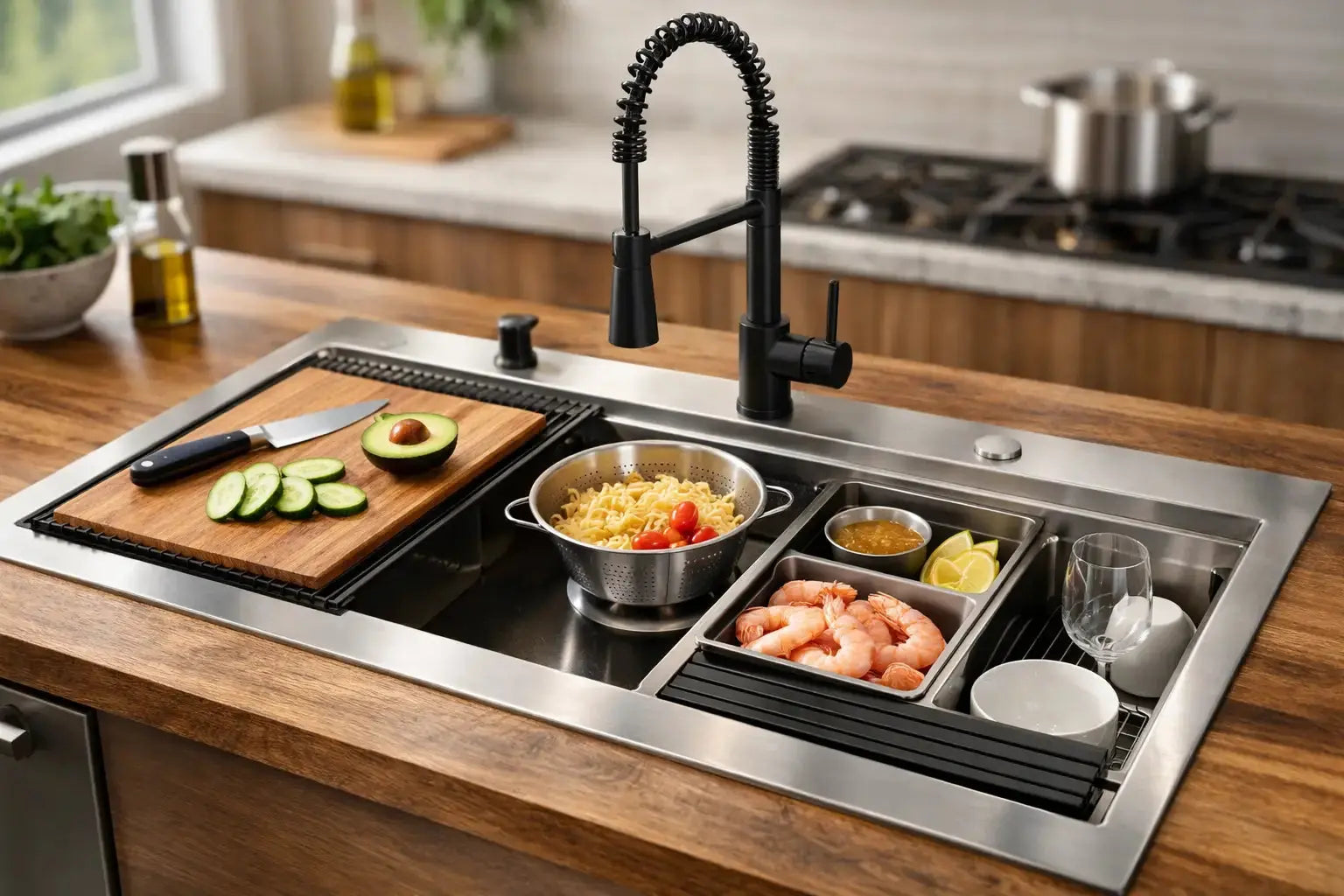
A workstation sink can look like a smart upgrade right up until you picture your actual kitchen routine. If you prep heavily, wash large cookware, or want to keep mess contained in one zone, workstation sink pros and cons are worth weighing carefully before you commit to the cutout, the cabinet, and the faucet setup.
This style of sink is built with integrated ledges that hold accessories such as cutting boards, colanders, drying racks, and prep trays. On paper, that sounds efficient. In the right kitchen, it is. But the value depends less on trend and more on how you cook, how much counter space you have, and whether you want your sink doing more than one job.
What makes a workstation sink different?
A standard kitchen sink is primarily for washing and rinsing. A workstation sink adds built-in tracks so accessories can slide across the basin. That turns the sink area into a compact prep station. You can rinse produce in a colander, chop on a fitted board, and let water and scraps stay over the bowl instead of spreading across the counter.
That design is especially appealing in condos, secondary suites, and busy family kitchens where every inch matters. It is also popular in design-led renovations because it creates a clean, integrated look. Many models are offered in stainless steel, though fireclay and other finishes are available depending on the brand and product line.
Workstation sink pros and cons for everyday use
The strongest case for a workstation sink is efficiency. The main drawback is that efficiency only works if the sink matches your habits.
Pro: It adds usable prep space
In smaller kitchens, a fitted cutting board over the sink can function like bonus counter space. That matters in compact urban layouts where uninterrupted work surfaces are limited. If your kitchen often feels crowded during meal prep, a workstation sink can help you use the footprint more intelligently.
For serious home cooks, this is one of the most practical advantages. You can move from washing to trimming to draining without crossing the kitchen. That can reduce clutter and keep food prep organized.
Pro: It contains mess well
Vegetable peels, rinse water, and drips stay in the sink zone instead of landing on the countertop or floor. That makes cleanup faster, especially when paired with accessories designed for draining and sorting. In households that cook daily, that containment can be more useful than the accessory count itself.
It is also useful when handling raw ingredients. Keeping prep close to the basin can make sanitation easier, provided the accessories are cleaned properly after use.
Pro: It can improve workflow
The best workstation sink setups support a clear sequence - rinse, prep, wash, dry. That is a practical advantage for homeowners who want the kitchen to function more like a work zone than a display space. Contractors and designers also like that these sinks can help a compact kitchen feel more capable without adding an island or extending cabinetry.
With the right basin size, the sink can also handle large pots, baking sheets, and oversized pans more comfortably than some double-bowl layouts.
Con: Accessories are only useful if you actually use them
This is where many buyers overestimate the value. A workstation sink may come with a cutting board, drying rack, colander, and grid, but not every household wants all of them in daily rotation. If the accessories end up stored in a drawer most of the time, the sink may offer less real benefit than expected.
Some buyers also assume all accessories are interchangeable. They are not. Many are brand-specific or model-specific, so replacing or expanding your setup later may be less flexible than buying standard kitchen tools.
Con: Cleaning can take more effort
A workstation sink has more components to wipe down, rinse, and store. Crumbs can collect in the ledges. Water spots can show on stainless accessories. If you prefer a low-maintenance sink area, this is a real consideration.
The basin itself is not necessarily harder to clean than a standard sink, but the full system usually requires more attention. That is especially true if you use wood cutting boards or roll-up drying racks that need regular care.
Con: It can crowd the sink when you need a clear basin
A workstation sink is designed to do more, but sometimes you want less happening at the sink. If accessories are in place while you are trying to fill a stockpot, wash a roasting pan, or clean up after a large meal, the setup can feel busy. In some kitchens, that layered design improves workflow. In others, it interrupts it.
This is one reason basin dimensions matter so much. A large single-bowl workstation sink often performs better than a smaller unit loaded with accessories.
Size, cabinet fit, and installation trade-offs
Before focusing on features, it helps to look at the practical fit. Workstation sinks are often larger, deeper, or heavier than basic models. That can affect cabinet compatibility, countertop planning, and installation labour.
Undermount versions are popular for a clean look, but they need suitable counter material and proper support. Farmhouse workstation sinks may require cabinet modification. Even top-mount models need accurate planning because the accessory system depends on precise interior dimensions.
Depth is another trade-off. A deeper sink can be excellent for washing cookware and hiding dishes between loads. But for some users, especially in lower counters or smaller kitchens, it can be less comfortable over long prep sessions. If multiple people use the kitchen, ergonomics should not be overlooked.
For trade professionals, the message is simple: check cutout specs, minimum cabinet width, accessory clearance, and faucet reach before ordering. A good sink can still be the wrong fit if the surrounding kitchen is not planned accordingly.
Cost versus value
One of the most common questions around workstation sink pros and cons is whether the upgrade is worth the price. Usually, a workstation sink costs more than a standard sink in the same material category. You are paying for integrated design, included accessories, and often a more premium product position.
That added cost can make sense if it replaces the need for separate prep tools or helps a small kitchen work harder. It can also make sense in higher-end renovations where buyers want a feature-rich sink paired with a better faucet and coordinated accessories.
But value depends on usage. If the kitchen is lightly used, or if the homeowner mainly wants a simple wash basin with easy upkeep, the extra spend may not deliver much day-to-day return. In that case, putting budget toward faucet quality, garbage disposal compatibility, or countertop space may be the better move.
Material matters more than many buyers expect
Most workstation sinks are stainless steel, and for good reason. It is durable, widely available, and practical for a high-use kitchen. Gauge, finish, sound dampening, and corner radius all affect how the sink performs and how easy it is to maintain.
A thinner or lower-quality stainless model can feel noisy and show wear more quickly. A better-built sink with proper insulation and a commercial-style finish usually holds up better in busy households.
If you are considering fireclay or another material, think beyond appearance. The accessories, ledge design, and overall sink weight may differ significantly. Material choice should support the kitchen's workload, not just its style direction.
Who should buy one and who should skip it?
A workstation sink tends to make the most sense for homeowners who cook often, want a more organized prep area, and are willing to maintain the accessory system. It is also a smart option in smaller kitchens where adding functional workspace has real value.
For renovators aiming at a more premium kitchen package, it can be a strong feature, especially when paired with trusted fixture brands and a coordinated faucet. Buyers comparing options through a broad selection, such as the kitchen sink assortment at Plumbing Market, will usually find that the best choice comes down to layout, cooking habits, and installation requirements rather than trend alone.
It may be less suitable for buyers who want a minimalist sink area, rarely cook, or dislike cleaning extra components. It can also be the wrong fit in kitchens where cabinet width, counter depth, or faucet placement create compromises from the start.
The real deciding factor
The best way to judge a workstation sink is not by the accessory list or the showroom appeal. It is by whether it solves a real problem in your kitchen. If you need more prep efficiency, better mess control, and a sink that supports how you cook, it can be an excellent upgrade. If you mainly need a straightforward basin that is easy to clean and easy to use, simpler options often perform better over time.
A good sink should make the kitchen easier to work in, not just easier to photograph. That is the standard worth buying to.


