

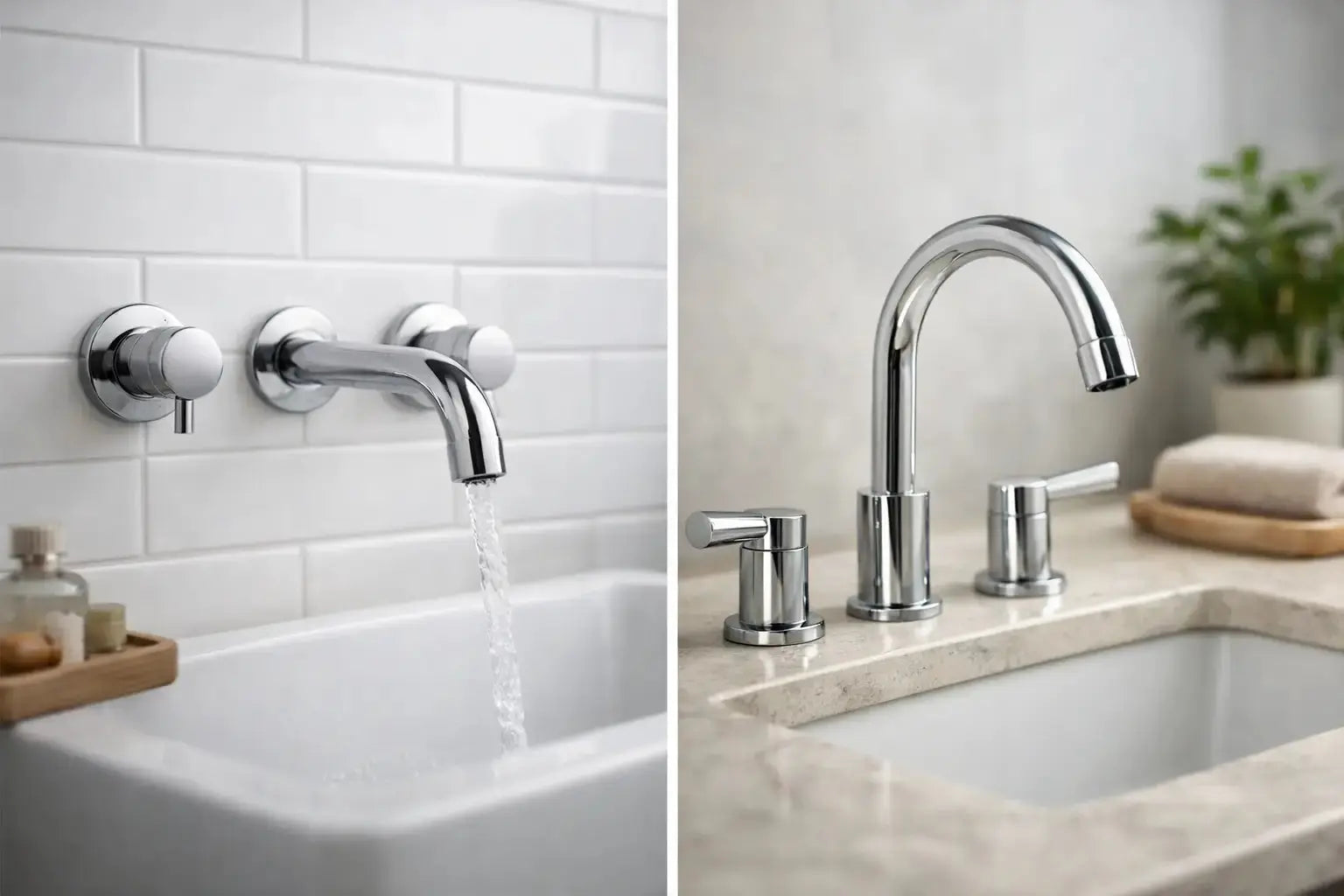
A faucet choice can affect far more than the look of a vanity or kitchen sink. In the wall mount vs deck mount faucet decision, the right option depends on where your water lines are located, the sink or countertop you select, and how much installation work the project can support. A wall-mounted model can create a clean, open counter surface. A deck-mounted model usually offers simpler replacement, wider product selection, and more flexibility when plumbing is already in place.
For homeowners, renovators, and trade professionals, the best choice is rarely about style alone. The faucet must match the sink dimensions, mounting holes, spout reach, valve requirements, and service access of the finished space.
Wall Mount vs Deck Mount Faucet: The Core Difference
A wall-mount faucet installs through the wall above the sink or countertop. Its spout and handles, or a single control handle, project from the finished wall surface. The supply connections and, in many models, the rough-in valve sit inside the wall.
A deck-mount faucet installs directly on a sink deck, vanity top, countertop, or kitchen counter. Depending on the model, it may use one hole, three holes, or a widespread configuration with separate hot and cold handles. The water connections remain below the counter, typically inside the vanity cabinet.
Both configurations are available in bathroom, kitchen, bar, utility, and commercial applications. However, wall mounting is most common for bathroom lavatories and some commercial wash basins. Deck mounting remains the standard choice for many kitchen sinks because it accommodates pull-down and pull-out spray functions, side sprayers, soap dispensers, and common sink drilling patterns.
Choose a Wall-Mount Faucet When Space and Cleaning Matter
A wall-mount faucet works particularly well with a vessel sink, an integrated basin, or a narrow vanity where countertop space is limited. Because the hardware is not installed on the counter, it leaves more room for toiletries and removes the tight area around a faucet base where water spots and residue tend to collect.
This configuration also creates a purposeful, design-forward result. A wall-mounted Brizo, Riobel, or Kohler lavatory faucet can make a simple vanity feel more tailored, especially when paired with a clean backsplash, floating vanity, or freestanding basin. It is also useful where a counter has no pre-drilled faucet holes or where the sink’s existing hole layout does not suit the desired fixture.
The practical advantage is the open surface below the spout. It is easier to wipe down a solid vanity top, and there is no faucet body crowding the rear ledge of the sink. In commercial washrooms, wall mounting can also keep the deck area clearer and support certain basin layouts.
The trade-off is planning. A wall-mount faucet needs the water supplies positioned correctly inside the wall before tile, stone, drywall, or other finishes are completed. The rough-in body must be compatible with the trim you choose. In many product families, the valve and visible trim are sold separately, so both components need to be specified before installation starts.
Get the rough-in height and spout reach right
Wall-mounted faucets are less forgiving than they appear. The spout must extend far enough to direct water near the basin drain, not onto the rear wall or front rim. It also needs adequate clearance above the sink for comfortable handwashing.
Before ordering, confirm the manufacturer’s technical drawing and measure the basin from the finished wall to the drain. Account for the backsplash thickness, tile build-up, countertop height, vessel sink height, and the final location of the wall face. A spout that is too short can cause splashing against the back of the basin. One that is too long may land water too close to the front edge.
Wall-mount height matters just as much. With an undermount or integrated sink, the faucet is generally mounted higher than with a standard deck-mounted fixture. With a vessel sink, it may need considerably more clearance. The exact dimension depends on the faucet aerator angle and sink depth, so use the fixture specifications rather than relying on a standard measurement.
Consider wall access before committing
Serviceability should be part of the decision, especially in condos, rental properties, and commercial spaces. Faucet cartridges and aerators are often accessible from the front once the trim is removed. But if a concealed connection develops a leak, wall access may be required.
Exterior-wall installations deserve extra care in Canadian climates. Plumbing in an exterior wall can be exposed to cold conditions if insulation, vapour barrier details, and pipe placement are not handled properly. A qualified plumber can assess whether an interior plumbing wall or an alternative layout is the better choice. This is not a reason to rule out wall mounting, but it is a reason to coordinate the fixture choice early.
Choose a Deck-Mount Faucet for Straightforward Installation
A deck-mount faucet is usually the practical choice for a direct replacement, a standard vanity renovation, or a kitchen installation using conventional sink and counter openings. The supplies connect below the deck, allowing the fixture to be installed and serviced from inside the cabinet instead of through the wall.
This makes deck-mounted models easier to change later. If a homeowner wants to replace a single-hole bathroom faucet, a plumber can generally disconnect the supply lines, remove the mounting hardware, and fit a compatible new model without opening finished surfaces. That flexibility is valuable in properties where finishes may be updated more frequently than rough plumbing.
Deck mounting also offers broad configuration choice. Single-hole faucets suit compact vanities and modern bathrooms. Centreset models fit common three-hole sink layouts. Widespread faucets allow separate handles and spouts with a more traditional or custom appearance. In kitchens, deck-mounted options include pull-down sprayers, high-arc spouts, touchless controls, filtration taps, and coordinated accessories.
For a kitchen renovation, the sink and faucet should be selected together. Confirm the number and spacing of sink holes, whether the faucet requires an escutcheon plate, and whether there is room behind the sink for the handle to operate. A pull-down faucet also needs sufficient cabinet clearance below for its hose and counterweight.
Watch the countertop and sink-hole layout
Deck-mount compatibility starts with drilling. A faucet designed for one hole may cover an existing three-hole opening only when an appropriate deck plate is available. A widespread faucet needs separate holes at the required spacing. Stone and solid-surface counters can be drilled, but changes after installation add cost and may not be advisable depending on the material and layout.
A faucet installed on a sink deck also needs enough flat, stable mounting area. Some farmhouse and workstation sinks have limited rear ledges, while certain vessel sinks have no faucet hole at all. In those cases, a wall-mount faucet or a counter-mounted tall vessel faucet may be the more suitable route.
Compare Installation Cost, Maintenance, and Daily Use
The fixture price is only one part of the wall mount vs deck mount faucet comparison. A wall-mount faucet can have a clean finished appearance, but its total installed cost may be higher when the project requires moving supply lines, framing a plumbing wall, installing a rough-in valve, or opening and refinishing tile. It is most cost-effective during a full renovation or new build, when the wall is already open.
Deck-mounted installation is generally less complex when existing plumbing enters through the vanity cabinet. It can still involve countertop drilling, sink changes, new shutoff valves, or supply-line adjustments, but the work is usually more accessible. For a like-for-like replacement, it is commonly the lower-disruption option.
Maintenance varies by model rather than mounting style alone. Both types may need periodic aerator cleaning, cartridge replacement, and inspection of supply connections. Hard water can leave mineral deposits on any finish, particularly around aerators and spray outlets. Use a non-abrasive cleaner suited to the manufacturer’s finish-care instructions, and avoid harsh products that can damage plated or specialty finishes.
Daily use should guide the final selection. Families may prioritize a dependable deck-mounted bathroom faucet with easy access beneath the vanity. A powder room may benefit from the visual impact and open counter space of a wall-mounted fixture. For commercial applications, consider flow rate requirements, vandal-resistant construction, sensor compatibility, accessibility needs, and the availability of replacement parts.
Questions to Confirm Before Ordering
Start with the installation location. Is the wall open, or is the plumbing already below the counter? Then verify the finished sink dimensions, faucet hole pattern, spout reach, handle clearance, and required rough-in components. For a wall-mounted fixture, confirm the valve depth range against the finished wall thickness. For a deck-mounted fixture, check that the cabinet provides room for supply hoses and any pull-down hose weight.
Finish coordination should come after fit and function. Chrome, brushed nickel, matte black, brass tones, and mixed-metal accents can all work well, but a faucet that does not align with the basin will never perform as intended. Selecting from established fixture lines also makes future cartridge and trim matching more manageable.
A wall-mounted faucet is worth the extra planning when it improves the vanity layout, supports the sink design, and can be roughed in correctly. A deck-mounted faucet is often the stronger choice when replacement simplicity, kitchen functionality, or under-counter service access is the priority. Measure the finished space, review the technical specifications, and choose the configuration that will remain practical long after the renovation is complete.


