

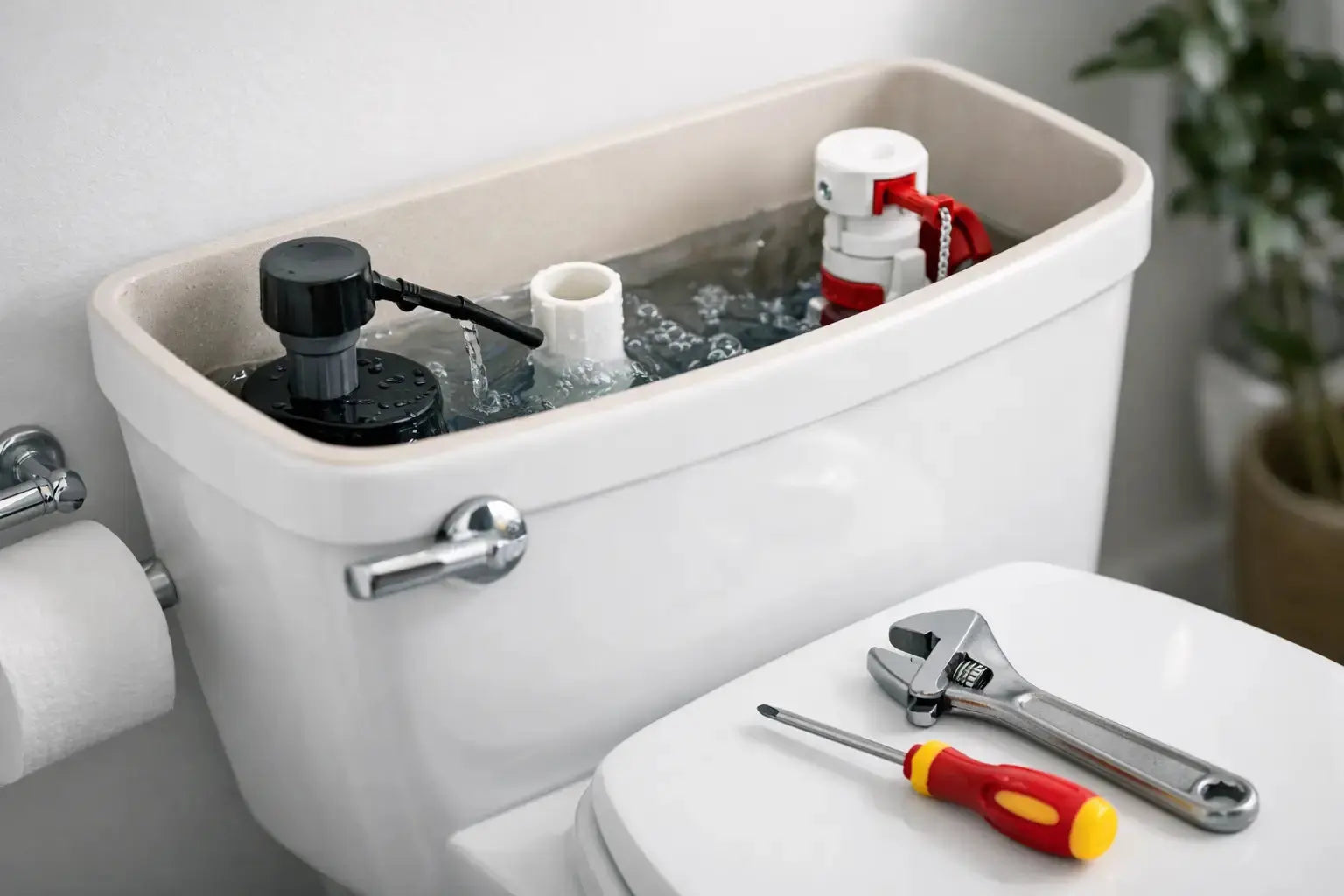
A toilet that refills on its own can be easy to ignore until the sound becomes constant, your water bill rises, or the tank starts cycling through the night. If you are asking, “why is my toilet running,” the issue is usually inside the tank: water is leaking into the bowl, the fill valve is not shutting off properly, or the water level is set too high. Most repairs involve a small number of replaceable components, but identifying the correct one before ordering matters.
Stop the Water Waste First
If water is actively flowing into the toilet bowl, remove the tank lid and place it somewhere safe. The lid is heavy porcelain and can crack if dropped. Locate the shutoff valve on the wall or floor behind the toilet and turn it clockwise to stop the supply if the toilet will not stop filling.
For a temporary test, lift the float on the fill valve while the tank is refilling. If the water stops, the fill valve or its adjustment is likely the problem. If water continues to enter the bowl after the tank reaches its normal level, focus on the flush valve, flapper, or canister seal.
A running toilet is not always an emergency, but it should not be left for weeks. A slow internal leak can waste a significant amount of treated water, particularly in homes with older fixtures or hard-working powder room toilets.
Why Is My Toilet Running After It Flushes?
A standard gravity toilet works by filling the tank to a set level. When the handle is pressed, the flapper or canister seal lifts, allowing tank water to flow into the bowl and start the flush. Once the tank empties, the seal closes and the fill valve refills the tank.
The toilet runs when that sequence does not fully reset. Either water escapes from the tank into the bowl after the flush, causing the fill valve to cycle back on, or the fill valve keeps adding water because it cannot detect or control the correct tank level.
The fastest way to narrow it down is to wait until the tank finishes filling. Listen for a faint refill sound, then look inside the bowl. Ripples near the back of the bowl or a visible trickle usually point to a leaking flush valve seal. Water flowing into the overflow tube points to a fill valve or float issue.
Common Causes of a Running Toilet
A worn flapper or canister seal
The flapper is the flexible rubber seal at the bottom of many toilet tanks. On other designs, especially certain modern toilets, a cylindrical canister seal performs the same job. Over time, rubber can warp, stiffen, collect mineral buildup, or develop small cracks. It may look intact but still fail to create a watertight seal.
This is the most common reason a toilet runs intermittently. The tank fills, water slowly leaks past the seal into the bowl, and the fill valve switches on every few minutes to restore the water level.
A simple dye test can confirm it. Add a few drops of food colouring to the tank and do not flush for 15 to 20 minutes. Colour appearing in the bowl means tank water is leaking past the flapper, canister seal, or flush valve seat.
Replacement parts must match the toilet’s flush system. A universal flapper can be a practical option for many conventional toilets, but it is not automatically suitable for every valve size, chain connection, or high-efficiency flush design. Where possible, use the toilet brand and model information from the inside of the tank or the original product documentation.
A chain that is too short, too long, or tangled
The lift chain connects the handle lever to the flapper. If it is too tight, it can hold the flapper slightly open after a flush. If it is excessively loose, it can slip beneath the flapper and prevent a proper seal. A tangled chain can create the same result.
There should be a small amount of slack when the flapper is closed. Adjusting the chain is quick, but avoid cutting it until the new position has been tested through several flushes.
A faulty or misadjusted fill valve
The fill valve controls the water entering the tank. Older toilets may use a float ball on a metal arm, while newer models typically use a compact float cup attached to the valve body. When the water level reaches its set point, the valve should shut off.
If the valve continues running and water spills into the overflow tube, lower the float setting according to the valve design. On many newer fill valves, this is done with an adjustment screw or clip. The ideal water level is usually marked inside the tank and should sit below the top of the overflow tube.
If adjustment does not stop the flow, replace the fill valve. Mineral deposits, worn internal seals, and age can prevent a valve from closing reliably. For a clean repair, confirm the tank height, water supply connection, and clearance around the flush valve before selecting a replacement.
An overflow tube that is set too low or damaged
The overflow tube prevents tank flooding by directing excess water into the bowl. If the tube is cracked, loose, or positioned incorrectly as part of the flush valve assembly, the toilet may run before the tank reaches its intended fill level.
Check that the small refill tube from the fill valve is clipped to the top of the overflow tube rather than pushed down inside it. If it is inserted too far, it can create a siphoning effect and slowly drain water from the tank. The refill tube should never extend below the overflow tube opening.
Mineral buildup on the flush valve seat
Even with a new flapper, water can leak if the surface it seals against is rough or coated with deposits. This is more likely in areas with mineral-heavy water. Turn off the supply, drain the tank, and inspect the flush valve seat for scale, nicks, or residue.
Light buildup can often be cleaned carefully with a non-abrasive pad. A cracked or damaged flush valve body usually requires replacement, which is a more involved repair because the tank must be removed from the bowl.
A problem with a dual-flush or pressure-assisted toilet
Dual-flush toilets use a tower, seal, or cartridge rather than a conventional flapper. A running issue may come from a worn base seal, an incorrectly seated flush tower, or a fill valve setting that does not match the tank’s water line. These parts are often model-specific, so a generic repair kit may not fit.
Pressure-assisted toilets and commercial flushometer systems require a different approach. Their internal cartridges, diaphragms, and control components are designed for specific valve bodies and operating pressures. If a commercial fixture continues to run, identify the manufacturer and valve model before replacing components. Using an incompatible diaphragm or cartridge can create poor flushing performance or continued leakage.
Choose Replacement Parts by Toilet Type
Before buying a repair part, record the toilet manufacturer, model number, approximate installation age, flush valve style, and tank opening size. The stamp inside the tank is often the most useful starting point. For a two-piece toilet, also note whether the tank uses a standard flapper, a large 3-inch flapper, or a canister-style flush valve.
For basic repairs, the most commonly required items are a compatible flapper or seal, a fill valve, a replacement flush lever, a refill tube, and a tank-to-bowl hardware kit if the tank must be removed. Contractors and property managers may prefer to keep several common sizes on hand, but brand-specific components remain the better choice for many premium and high-efficiency toilets.
A full repair kit can be good value when both the fill valve and flapper are aging. If the toilet is relatively new and only one component has failed, replacing the individual part is usually the more efficient option.
Repair It or Replace the Toilet?
A running toilet does not automatically mean the fixture needs replacement. A flapper, seal, or fill valve repair is generally straightforward and economical when the bowl and tank are in good condition. Replacement becomes more reasonable when the toilet has recurring leaks, visible porcelain damage, unreliable flushing, obsolete internal parts, or inefficient water use.
For a bathroom renovation, upgrading to a high-efficiency toilet can reduce water use while improving bowl wash and flush consistency. However, rough-in size, bowl shape, seat height, flushing technology, and available wall clearance should all be confirmed before selecting a new fixture. A 12-inch rough-in is common in Canadian homes, but 10-inch and 14-inch configurations also exist.
When to Call a Plumber
Call a qualified plumber if you find a cracked tank, leaking tank-to-bowl bolts, a failed shutoff valve, water on the floor, or damage to the flush valve that requires tank removal. Professional help is also worthwhile for concealed-cistern toilets, pressure-assisted units, and commercial flush valves where correct parts and pressure settings are essential.
For most standard toilets, start with the simplest test: confirm whether water is leaking into the bowl or entering the overflow tube. That one observation will usually point you to the right repair part and turn an irritating refill sound into a quick, manageable fix.


