

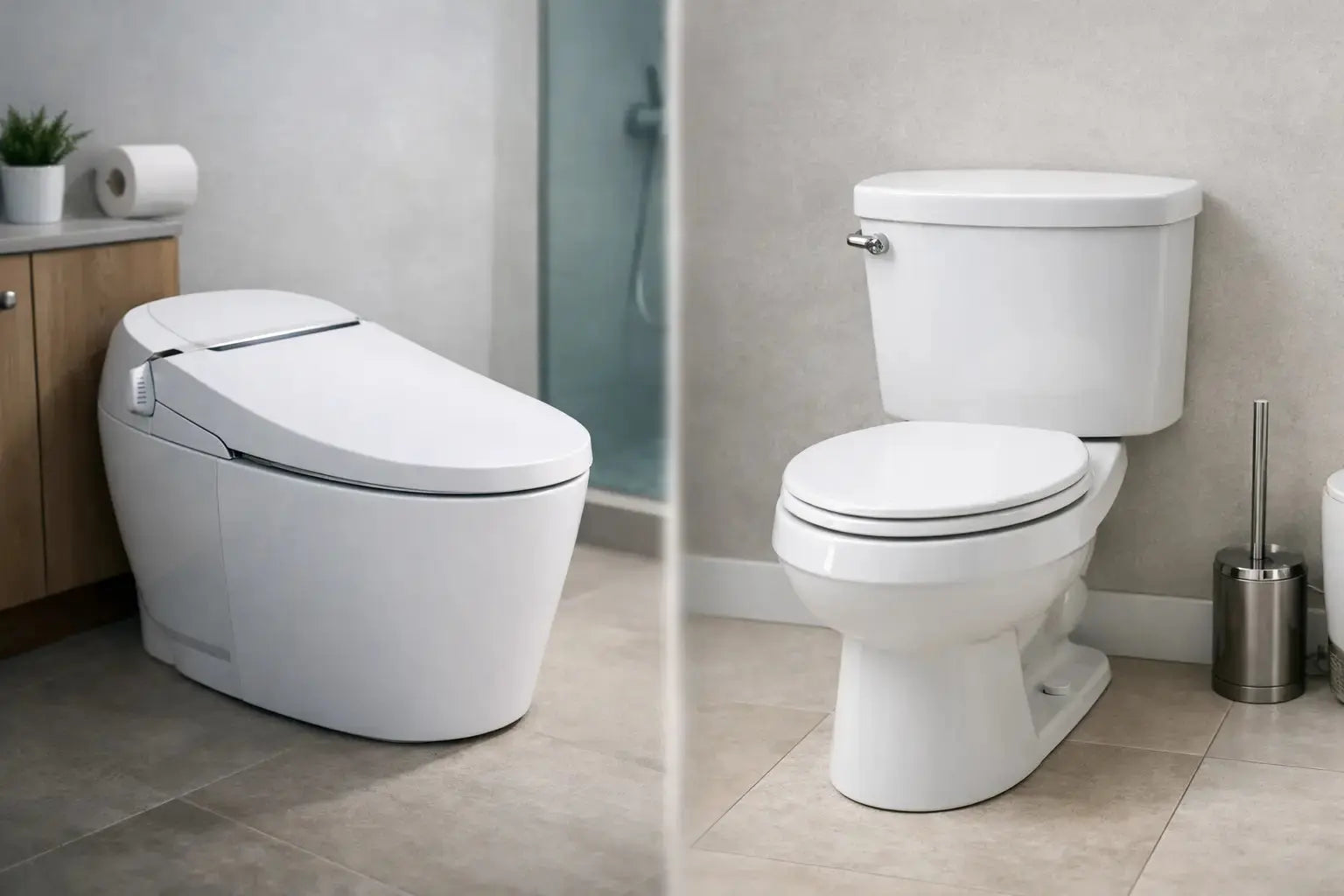
A toilet choice usually feels simple until you start pricing a renovation, reviewing feature lists, and thinking about who will actually use the bathroom every day. In the smart toilet vs traditional toilet debate, the right answer depends less on trend and more on budget, plumbing layout, maintenance expectations, and the level of comfort you want from the space.
For some buyers, a standard floor-mounted toilet remains the most practical option - proven, familiar, and easy to service. For others, a smart toilet adds meaningful daily benefits, especially in primary ensuites, luxury renovations, aging-in-place plans, and high-use residential or commercial settings where hygiene and user comfort matter.
Smart toilet vs traditional toilet: the core difference
A traditional toilet does one job. It flushes waste efficiently, uses a tank or tankless mechanism depending on the model, and typically relies on manual operation. You can choose between one-piece and two-piece designs, elongated or round bowls, standard or comfort height, and a range of flush technologies, but the product category itself is straightforward.
A smart toilet starts with that same basic function and adds integrated technology. Depending on the model, that can include an automatic flush, bidet washing, heated seat, warm air dryer, deodorizer, night light, remote control, touchless operation, and personalized settings. Some units are fully integrated smart toilets, while others pair a conventional toilet with an advanced bidet seat.
That distinction matters. A fully integrated unit offers a cleaner look and a more complete feature set, but it also raises the price and installation complexity. A traditional toilet with a bidet seat can deliver part of the smart experience at a lower entry cost.
Where a traditional toilet still makes the most sense
Traditional toilets remain the default choice for a reason. They are generally less expensive to buy, easier to install, and simpler to repair with widely available replacement parts. For guest baths, rental properties, secondary powder rooms, and budget-conscious renovations, that practicality often outweighs any added convenience from smart features.
They also give buyers more flexibility across rough-in sizes, bowl shapes, flushing systems, and price points. If you are outfitting multiple bathrooms at once, sticking with traditional toilets can keep the project consistent and easier to manage. Contractors and plumbers often favour them in straightforward replacement jobs because there are fewer variables during installation.
There is also the service factor. Most homeowners already understand how a standard toilet works. If a flapper, fill valve, handle, or wax seal needs replacement, the repair path is familiar. In many cases, maintenance can be handled quickly without specialized troubleshooting.
Where a smart toilet earns its price
The best case for a smart toilet is daily use. When a bathroom is part of a higher-end remodel or a comfort-focused upgrade, the added features are not just cosmetic. Heated seating is noticeable in a Canadian winter. Built-in bidet washing can improve hygiene while reducing toilet paper use. Touchless flushing and self-cleaning functions can help keep the fixture cleaner between deep cleans.
A smart toilet can also support accessibility. For users with mobility concerns, limited range of motion, or sensitivity to colder surfaces, hands-free features and wash functions can make the bathroom easier to use. That is one reason these models often appeal to aging homeowners planning long-term renovations rather than short-term cosmetic updates.
Design is another factor. Many smart toilets have a streamlined, modern profile that fits contemporary bathrooms, especially when paired with wall-hung vanities, minimalist faucets, and clean-lined shower systems. In a design-led ensuite, a basic toilet can sometimes feel out of step with the rest of the spec.
Cost is not just the sticker price
If you compare smart toilet vs traditional toilet on purchase price alone, traditional models usually win by a wide margin. A standard toilet can cover a broad range from value-focused builder models to premium branded options with improved flushing performance and refined design. Smart toilets start higher and can climb quickly depending on the level of integration and technology.
But the purchase price is only one part of the decision. Installation costs may increase if a smart toilet requires a nearby electrical outlet, upgraded circuit planning, or more precise fitment. If the bathroom is already being renovated, adding power at the toilet location is easier and less disruptive. In a finished bathroom, that same requirement can change the economics.
Long-term value is more subjective. If the smart features are used every day and improve comfort, cleanliness, or accessibility, the premium can be justified. If the toilet is in a basement bathroom used a few times a week, the return is harder to defend.
Installation and renovation planning
This is where many buying decisions become clearer. A traditional toilet replacement is usually straightforward if the rough-in size matches and the existing plumbing is in good shape. That makes standard models attractive for repair-driven projects, quick upgrades, and investment properties where time matters.
A smart toilet needs more planning. Beyond dimensions and rough-in, you need to confirm power access, clearance, and the manufacturer's installation requirements. Some integrated models also have specific water supply expectations or seat-lid clearances that can affect surrounding cabinetry or wall conditions.
For renovators, the ideal time to choose a smart toilet is before rough-in and finish decisions are locked. That allows the electrician, plumber, and designer to coordinate properly. For a simple like-for-like swap in an older home, a traditional toilet - or a traditional toilet paired with a compatible bidet seat - may be the cleaner path.
Maintenance, repairs, and real-world ownership
Every toilet needs maintenance. The question is what kind.
Traditional toilets typically involve mechanical parts that are inexpensive and familiar to service. Fill valves, flush valves, handles, and seals are common replacement items. Parts are widely available, and many plumbers can complete repairs quickly with minimal diagnostic work.
Smart toilets introduce electronics, sensors, and more specialized components. That does not make them unreliable by default - premium brands have invested heavily in performance and quality control - but it does mean repairs can be more product-specific. If an integrated dryer, remote function, or sensor system fails, the service process may not be as simple as replacing a standard tank part.
This is why brand selection matters. Established manufacturers with strong support and parts availability are generally the safer choice, especially for a fixture that combines plumbing and electronic functions. For buyers comparing high-end bathroom products, that support should be part of the value equation, not an afterthought.
Hygiene, water use, and everyday comfort
One of the strongest arguments for smart toilets is hygiene. Integrated bidet functions provide a level of cleansing that toilet paper alone does not. Many models also include pre-mist bowl functions, automatic flush options, and antimicrobial or easy-clean surfaces.
That said, traditional toilets can still perform extremely well on hygiene and efficiency if you choose a strong flushing design and quality glazing. Water-saving performance is not exclusive to smart models. Many conventional toilets now meet strict efficiency standards while maintaining solid flush performance.
Comfort is where the gap becomes more noticeable. Heated seats, adjustable wash settings, and user presets can change how the bathroom feels in daily use. Whether that matters depends on the bathroom's role. In a main ensuite, it often does. In a kid's bathroom or a low-use guest room, maybe not.
Which option works best for different buyers?
For homeowners doing a practical update, a traditional toilet is often the better fit. It keeps costs controlled, simplifies installation, and offers plenty of design and performance options. If the goal is dependable function with minimal complexity, it is still the category leader.
For premium renovations, smart toilets make more sense when the rest of the room is already being upgraded to a higher standard. If you are investing in better tile, fixtures, lighting, and shower systems, a smart toilet can align with the overall spec rather than feeling like an isolated luxury item.
For contractors and trade buyers, the decision usually comes down to project type. Volume residential jobs, rental units, and basic replacements tend to favour traditional toilets. Custom homes, upscale condos, and accessibility-focused projects are where smart toilets can add real value.
For commercial buyers, it depends on the application. Public washrooms often prioritize durability, serviceability, and vandal resistance, which supports more traditional commercial-grade fixtures. Private hospitality or executive washroom settings may justify smart features where comfort and presentation are part of the experience.
Smart toilet vs traditional toilet: how to decide
If your priorities are lower upfront cost, simpler installation, and easy servicing, choose a traditional toilet. If your priorities are comfort, hygiene, design impact, and advanced functionality, a smart toilet is worth serious consideration.
If you are somewhere in the middle, the best compromise may be a quality traditional toilet paired with a bidet seat. That approach gives you access to key smart features without fully committing to an integrated unit. For many Canadian households, it is the most balanced upgrade path.
A toilet is one of the most used fixtures in any property, so the right choice should reflect how the space actually performs, not just how it looks on a spec sheet. When you compare carefully - and source from a supplier with strong category depth across toilets, bidet seats, rough-in components, and replacement parts - the better option usually becomes obvious.


