

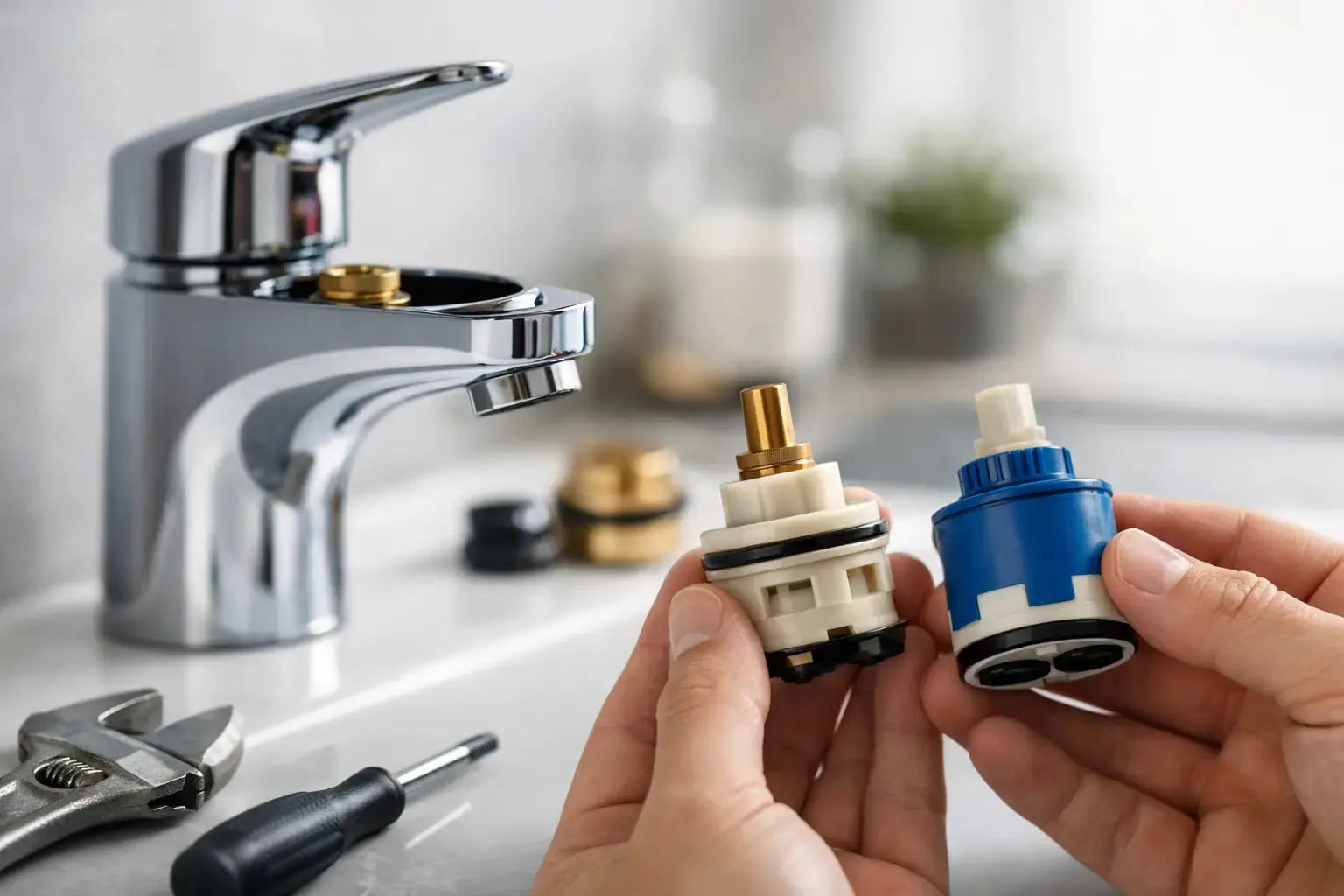
A faucet that drips after you shut it off usually points to one small part: the cartridge. The problem is that figuring out how to identify faucet cartridge models is often harder than replacing one. Two cartridges can look nearly identical, but a small difference in stem length, broach pattern, or retaining clip style can mean the replacement will not fit.
If you want to get it right the first time, treat cartridge identification like a parts-matching job, not a guess. Brand matters, but so do dimensions, handle style, and the way the cartridge locks into the valve body. For homeowners, renovators, and trade buyers, that extra care saves a return, a second teardown, and one more trip back to the sink.
How to identify faucet cartridge without guessing
The fastest path is to identify the faucet brand and model first, then confirm the cartridge by visual and physical details. If the brand is still visible on the trim, spout, handle cap, or escutcheon, start there. Kohler, Riobel, Brizo, Delta, Moen, American Standard, and Grohe all use cartridge families with specific shapes and fitments, and brand information narrows the field quickly.
If there is no visible model number, remove the handle and trim carefully so you can inspect the working parts. Shut off the water supply first. Once the handle is off, look at the cartridge stem, overall body shape, colour, number of O-rings, tabs, grooves, and retaining method. Some cartridges are held by a bonnet nut, while others use a U-shaped retaining clip. Those details matter because many replacement parts are identified by this exact combination.
Photos help, but measurements close the gap. Measure the cartridge length from base to stem tip, the body diameter, and the stem profile where the handle attaches. A difference of even a few millimetres can separate one model from another.
Start with the faucet type
Before you compare parts, determine what kind of faucet you have. A single-handle lavatory faucet typically uses a different cartridge style than a two-handle widespread faucet or a tub and shower trim set. Kitchen faucets with pull-down spray heads can have brand-specific cartridge assemblies that are not interchangeable with standard bathroom sink cartridges.
Compression-style faucets with rubber washers are a different category altogether. If you remove the handle and find a stem with a screw-on washer at the bottom rather than a cartridge body with seals and ports, you are not dealing with a modern cartridge faucet. That distinction saves time because washer and stem replacements are sourced differently.
Ceramic disc cartridges are common in premium fixtures and often feel smoother in operation. Pressure-balance and thermostatic cartridges, usually found in showers, are more specialized and should be matched even more carefully because performance and temperature control depend on the correct internal design.
The details that actually identify the cartridge
Once the faucet is apart, the cartridge itself gives you most of the clues you need. The stem is one of the first places to look. Its shape where the handle fits on top, often called the broach, can be splined, square, D-shaped, or geared. The number of splines and their arrangement are key identifiers.
Body shape is just as important. Some cartridges are cylindrical and plain, while others have ears, wings, flat sides, locator pins, or stepped sections that align with the valve body. If the cartridge has tabs that index into the faucet, a similar-looking cartridge without those tabs will not seat correctly.
Retaining style helps narrow it down further. A brass bonnet nut suggests one style of assembly. A horseshoe or U-clip suggests another. Cartridges for hot and cold sides in two-handle faucets may also be handed, meaning the hot side and cold side are not always the same part.
Material and colour can also point to a cartridge family. Many manufacturers use white, blue, grey, black, or beige plastic bodies for specific part lines. Colour alone is never enough, but when it matches the brand and dimensions, it becomes a useful confirmation.
Brand and model number make the job easier
If the faucet is still installed and you can identify the manufacturer, check common label locations before taking more apart. Model numbers may appear on the original box, installation guide, invoice, or underside of the sink near the faucet mounting hardware. In renovation and commercial settings, older records can save a lot of time.
For branded faucets, the cartridge is often tied to a limited range of models or production years. That matters because manufacturers sometimes change cartridge designs mid-cycle. An older version and a newer version may fit the same trim visually but use different internals. If your faucet was installed ten or fifteen years ago, do not assume the current cartridge shown for that collection is identical.
This is where a selection-focused supplier can help. If you are comparing replacement parts across major brands and technical subcategories, accurate product photos and specifications make it much easier to verify fit before ordering.
How to remove the cartridge safely for identification
When people damage a faucet during identification, it is usually because the cartridge is stuck and they force it. Mineral buildup, corrosion, and long service life can lock the body into the valve. Shut off the water, open the faucet to relieve pressure, and protect finished trim before you start.
Remove the handle screw, then the handle, then any decorative cap or trim sleeve. Take out the retaining clip or bonnet nut. If the cartridge does not pull straight out, wiggle gently while pulling upward. Cartridge pullers can help on stubborn units, especially in older kitchen and bath faucets.
Do not twist aggressively unless the design specifically calls for it. Plastic tabs can shear off, and once that happens, identification gets harder. If the cartridge breaks during removal, keep every piece. Even a damaged stem or seal layout can help match the replacement.
Common mistakes when learning how to identify faucet cartridge parts
The biggest mistake is matching by appearance alone. Many cartridges look close enough in an online photo, but stem height, port layout, or indexing tabs can differ. That is why measuring and checking retaining style are essential.
Another common mistake is ordering based only on faucet brand. A single manufacturer may have dozens of cartridge types across lavatory, kitchen, roman tub, shower, and commercial applications. Brand narrows the search, but it does not complete it.
People also mix up complete cartridges with repair kits. Some faucets allow replacement of seals, springs, or ceramic inserts rather than the full cartridge body. If the listing is for a service kit and your original cartridge housing is cracked or worn, that kit will not solve the problem.
The last issue is skipping left-hand and right-hand orientation. In two-handle faucets, hot and cold cartridges may open in different directions or use mirrored designs. Always confirm whether the part is universal or side-specific.
When the cartridge has no markings
Unmarked cartridges are common in older fixtures, private-label products, and some import faucets. In that case, rely on a combination of dimensions, stem profile, retaining method, and faucet application. Take the cartridge out fully and photograph it from several angles: side view, top of stem, bottom ports, and any tabs or grooves.
Measure overall height, base diameter, stem diameter, and visible spline count if applicable. Note whether the faucet is a bathroom sink, kitchen sink, tub filler, or shower valve. Those details often make the difference between a correct match and a near miss.
If the faucet itself has no clear branding and the cartridge is generic-looking, compare construction quality and trim style. Premium faucets typically use more refined cartridges with tighter tolerances and better ceramic internals. Lower-cost faucets may use generic replacements that fit multiple private-label lines, but even then, dimensions still have to match.
What to do before you order a replacement
Before buying, compare four things against the product information: brand compatibility, cartridge dimensions, stem or broach configuration, and retaining system. If one of those does not align, stop and verify again. A replacement that is almost right usually ends in another removal job.
It also helps to think beyond the cartridge itself. If the faucet has been leaking for a while, inspect O-rings, seats, springs, and trim seals while you have it apart. In hard water areas, mineral buildup can wear related components and affect how the new cartridge performs.
For trade buyers and renovation projects, it is often worth replacing both hot and cold cartridges at the same time on two-handle fixtures if they are the same age. If one side has failed, the other may not be far behind.
Getting the right cartridge is less about luck and more about reading the clues the faucet gives you. Slow down, measure carefully, and match the technical details before you order. A few extra minutes at the sink usually saves hours once the replacement arrives.


