

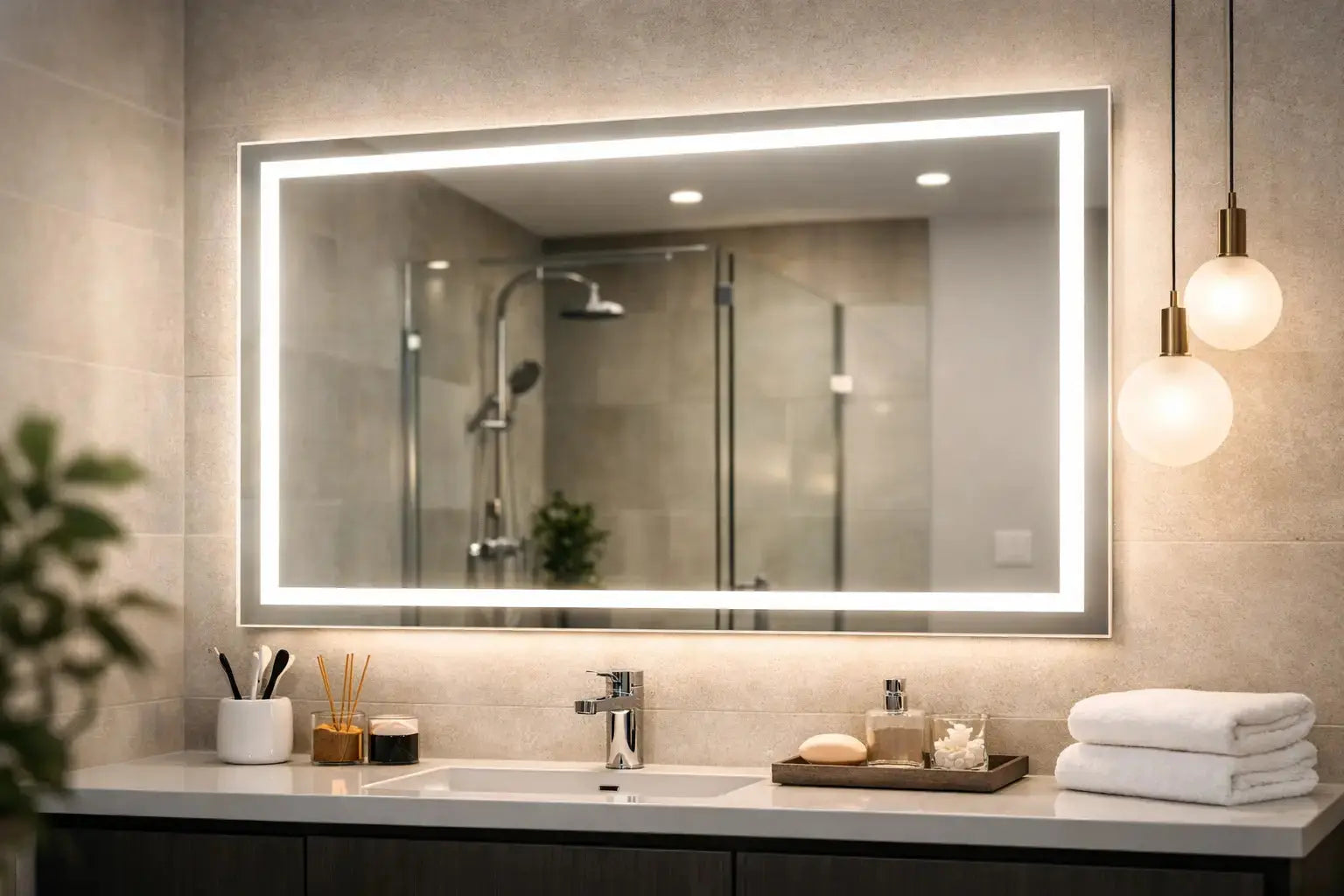
A bathroom mirror can look right in a product photo and still feel wrong the moment it is switched on. The best bathroom mirror with lights needs to do more than brighten the wall. It has to suit the vanity size, give usable task lighting, handle humidity, and fit the level of finish expected in a primary bath, powder room, or commercial washroom.
For most buyers, the decision comes down to a few practical questions. Is the lighting even enough for shaving, makeup, and daily grooming? Does the mirror size match the vanity and faucet layout? Is the colour temperature flattering without making the room feel cold? And if this is a renovation, will the electrical rough-in support the mirror you want? Those details matter more than trendy extras.
What makes the best bathroom mirror with lights?
The best choice is not automatically the brightest model or the one with the most features. In a residential ensuite, buyers often want a clean, modern mirror with integrated LED lighting, a slim profile, and anti-fog performance. In a family bath, durability and easy operation usually matter more than touch controls or built-in speakers. In commercial settings, consistency, low maintenance, and reliable illumination tend to take priority.
A good lighted mirror should provide balanced facial lighting rather than a harsh halo that creates shadows under the eyes or chin. This is where LED placement matters. Front-lit mirrors usually offer better task visibility because the light is directed outward toward the user. Backlit mirrors often create a softer ambient effect and can look more architectural, but some models do not provide enough direct light on the face unless the bathroom has strong overhead fixtures as well.
That is why the best bathroom mirror with lights often depends on how the bathroom is used. If the mirror is the main grooming light, front-lit or combined front-and-back-lit designs are usually the better fit. If the room already has layered lighting, a backlit mirror can work well as a design feature.
Size and proportion matter more than most buyers expect
A mirror that is too small can make a vanity look unfinished. A mirror that is too large can crowd side sconces, interfere with medicine cabinets, or feel oversized in a compact bathroom. In most cases, the mirror should be slightly narrower than the vanity. This keeps the composition balanced and avoids an awkward edge-to-edge look.
Height also matters. Taller mirrors can make a room feel larger, but they need to align with faucet height, backsplash depth, and any nearby shelving or tile transitions. If you are selecting for a double vanity, you may need to decide between one wide mirror and two separate mirrors. One large unit can create a cleaner contemporary look, while two mirrors often suit traditional layouts and make centring over each sink easier.
For Canadian renovators working with condo bathrooms or older homes, wall space is often tighter than expected once electrical boxes, tile lines, and side clearances are factored in. Measuring only the vanity width is not enough. You need the full wall plan before ordering.
Light quality is where good mirrors separate from average ones
Brightness alone is not the full story. The colour temperature of the LEDs has a major effect on how the bathroom feels and how accurately skin tones are shown. Warmer light, around 3000K, feels softer and more residential. Cooler light, around 4000K to 5000K, feels cleaner and brighter, which some buyers prefer for grooming tasks.
There is no single right answer here. A warm LED mirror can feel more comfortable in a relaxed ensuite, but it may not offer the same crisp visual clarity some users want for makeup application or shaving. A cooler mirror can be more functional, but if the rest of the bathroom finishes lean warm, it may feel clinical. Adjustable colour temperature is useful if multiple people use the same space and have different preferences.
Dimming is another feature worth paying for when the bathroom serves more than one purpose. Full brightness works well in the morning. Lower light levels are often better at night, especially in powder rooms or ensuites where softer lighting improves comfort.
Features that are useful and features that are optional
Anti-fog is one of the few upgraded features that often earns its place. In bathrooms with frequent showers, a demister pad helps keep the centre of the mirror clear and reduces the need to wipe the glass. It is especially helpful in tighter bathrooms with limited ventilation.
Touch sensors, motion activation, and memory settings can also be worthwhile, but they depend on the user. Touch controls look clean, though some buyers prefer a hardwired wall switch for reliability and simpler operation. Memory functions are convenient when they return the mirror to a preferred brightness or colour setting after power cycling.
Built-in clocks, Bluetooth speakers, and magnifying sections are more situational. They can be useful in some residential projects, but they are not essential to choosing the best bathroom mirror with lights. In many cases, a simpler mirror from a trusted manufacturer is the stronger long-term purchase.
Installation should be part of the buying decision
Many lighted mirrors require hardwired installation, which means planning for an electrical connection behind the mirror. That is straightforward during a renovation or new build, but it can add work in a finished bathroom where the wall is already tiled or painted. Plug-in options exist, but they are generally less streamlined and may not suit higher-end vanity designs.
Weight is another consideration. Larger mirrors may need secure anchoring, particularly on tile walls or in commercial environments where durability matters. If the mirror includes heating elements, dimming controls, or integrated drivers, you also want to confirm service access and compatibility with local electrical requirements.
For contractors and trade buyers, this is where product documentation matters. Dimensions, wiring requirements, mounting method, and driver placement should all be checked before the fixture is ordered. A well-priced mirror is not a good value if it complicates installation or delays a project.
Matching the mirror to the bathroom style
Most lighted bathroom mirrors lean modern, but there is still a wide range within that category. Frameless mirrors with thin illuminated borders work well in contemporary spaces with floating vanities, wall-mounted faucets, and large-format tile. Rounded rectangles and pill-shaped mirrors soften a room and pair nicely with warmer finishes such as brushed gold, champagne bronze, or wood vanities.
If the bathroom includes strong decorative elements, such as statement sconces or ornate millwork, an integrated lighted mirror may compete with the design rather than improve it. In that situation, a standard mirror with separate vanity lighting may be the better route. The best bathroom mirror with lights is not always the best bathroom mirror for every room.
This is particularly true in powder rooms. These spaces often benefit from more decorative lighting and less task-driven illumination. In primary bathrooms, however, a well-chosen LED mirror can improve both daily function and the overall finish of the vanity wall.
How Canadian buyers can narrow the field faster
Start with the basics: vanity width, available wall height, and whether the mirror will be the main source of face lighting. From there, focus on LED type, colour temperature, and anti-fog capability. If the bathroom gets heavy daily use, choose reliability over novelty.
Brand and product support also matter. Buyers sourcing through a category-focused retailer such as Plumbing Market can compare bathroom lighting, vanities, faucets, and technical components in one place, which makes it easier to match finish direction and installation needs across the full project. That is especially useful when the mirror is only one part of a larger renovation schedule.
If you are selecting for a rental unit or commercial washroom, prioritize simple controls, durable construction, and easy replacement planning. If you are outfitting a custom ensuite, spend more time on light tone, edge design, and how the mirror works with the rest of the lighting plan.
Common mistakes to avoid
The most common mistake is treating the mirror as a decorative afterthought. Once lighting performance is poor, the bathroom feels less functional every day. Another frequent issue is choosing a mirror based on dimensions alone without checking lumen output, anti-fog coverage, or whether the light direction supports grooming tasks.
Buyers also underestimate how reflective light interacts with surrounding finishes. Glossy tile, polished chrome, and white quartz can amplify brightness. Matte black fixtures, darker paint, and textured tile absorb more light. The same mirror can feel very different from one bathroom to another.
A final point worth keeping in mind is lifespan. Integrated LED mirrors can offer clean design and efficient lighting, but they are still electrical products used in a humid environment. Choosing reputable construction and installation-ready specifications is usually smarter than chasing the lowest price.
The right mirror should make the vanity work better every morning, not just look sharp on day one. If you begin with lighting quality, size, and installation realities, the design choice becomes much easier.


