

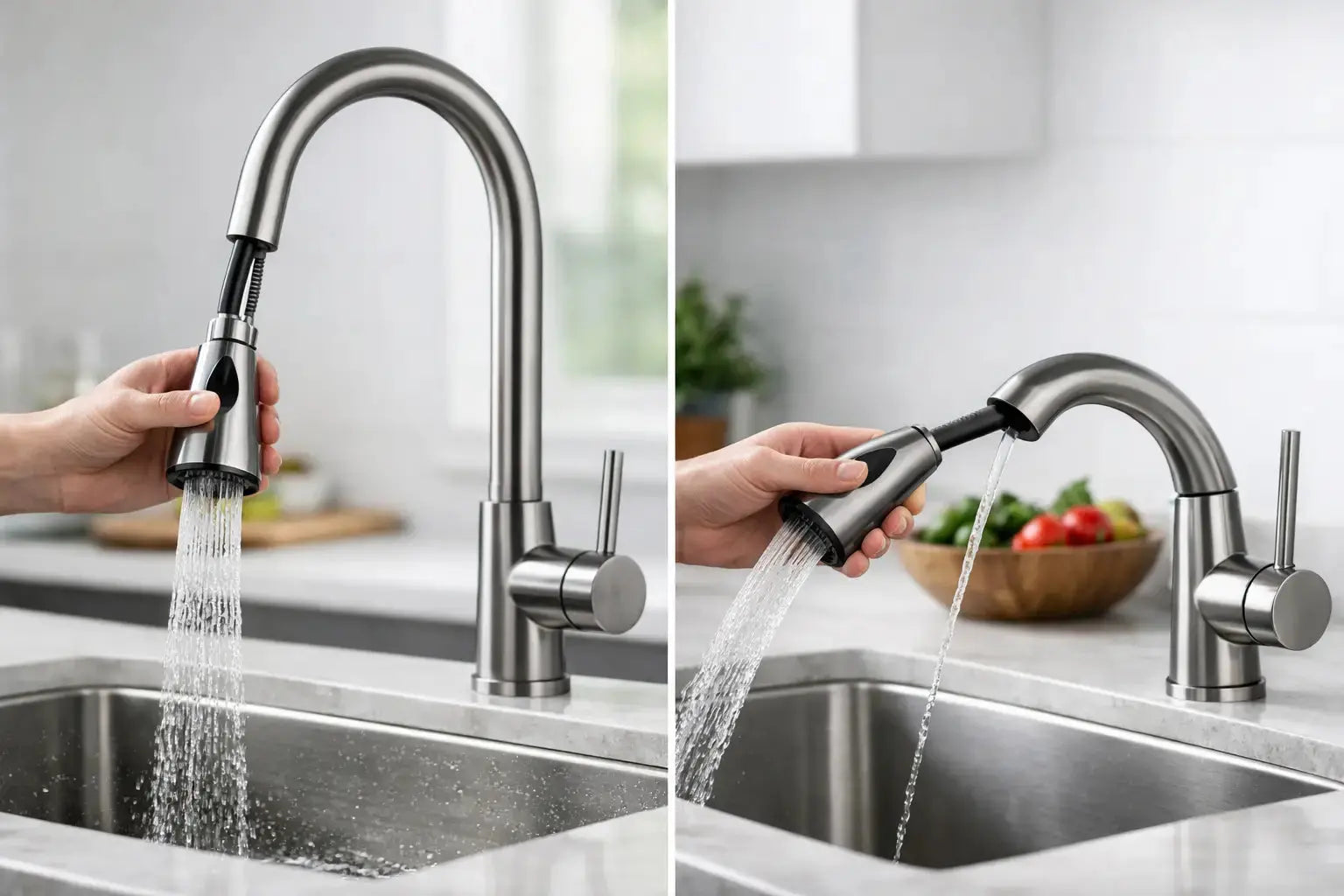
If you are choosing a new kitchen tap, the pull down vs pull out faucet decision usually comes down to one thing: how you actually use your sink every day. A tall, deep workstation sink has different demands than a compact condo kitchen, and the right spout style can make rinsing pans, filling pots, and cleaning corners noticeably easier.
Both styles use a spray head that detaches from the spout, which is why they are often grouped together. The difference is in the direction the spray head travels and the shape of the faucet body itself. That change sounds minor on paper, but in practice it affects clearance, reach, splash control, and how the faucet looks in the room.
Pull down vs pull out faucet: the core difference
A pull-down faucet has a high-arc spout and a spray head that pulls straight down into the sink. It is the format many homeowners picture in a modern kitchen, especially in larger spaces with wide basins and generous counter depth. The taller profile gives you more vertical room under the spout, which is useful for stock pots, roasting pans, and oversized prep bowls.
A pull-out faucet usually has a lower profile, and the spray head pulls outward toward you rather than dropping down from a high arc. The hose still gives you flexibility, but the overall form is more compact. That makes it a practical option where upper cabinets, shelves, or window trim limit height above the sink.
Neither is automatically better. The right choice depends on sink size, kitchen layout, and how much you value a tall statement fixture versus a more restrained, space-efficient design.
How each faucet style works in a real kitchen
In day-to-day use, pull-down faucets tend to feel more natural in deeper sinks. The spray head tracks downward into the bowl, so rinsing produce, blasting food off plates, or washing the sink walls feels direct and controlled. If your sink is large enough, that extra height becomes an advantage rather than empty space.
Pull-out faucets often perform better in smaller kitchens because the spray can be guided sideways with less exaggerated movement. If you regularly fill coffee makers, kettles, pet bowls, or buckets placed near the sink, a pull-out model can be easier to aim beyond the basin edge. That outward reach is one of its most practical advantages.
There is also a difference in ergonomics. Pull-down models usually ask for a bit more vertical motion. Pull-out models tend to feel lighter and more compact in hand, particularly for users who want simpler control in tight quarters.
Sink size matters more than most buyers expect
The faucet should suit the sink, not just the finish or silhouette. A pull-down faucet paired with a small, shallow basin can create more splash than expected, especially if the stream is forceful and the spray head sits high above the bottom of the sink. In a deep single-bowl sink, the same faucet can feel perfectly proportioned.
A pull-out faucet is often easier to fit to shallower or narrower sinks because the lower spout reduces the drop distance from aerator to basin. That can help with splash control and make the whole work area feel less crowded. In compact kitchens, this matters more than appearance alone.
For double-bowl sinks, either option can work well, but hose mobility becomes more important. If you move between bowls constantly for prep and cleanup, pay attention to hose length, docking strength, and spray-head balance rather than choosing by silhouette alone.
When a pull-down faucet makes more sense
A pull-down faucet is often the stronger fit if you have a large sink, plenty of overhead clearance, and a preference for a more contemporary kitchen profile. It also suits households that do a lot of cooking and dishwashing by hand. The higher arc creates a roomy work zone, and many premium models pair that shape with strong docking systems and multi-function spray settings.
This style is also common in design-forward kitchens where the faucet is expected to carry visual weight. Brands such as Riobel offer pull-down models in finishes and forms that work well in both transitional and modern spaces.
When a pull-out faucet is the smarter buy
A pull-out faucet is often the better choice for smaller kitchens, secondary prep sinks, bar sinks, or layouts with lower cabinets above the sink. If practicality is the priority, the compact body can be easier to live with. It gives you flexibility without demanding as much visual or physical space.
It can also be the safer option when replacing an older faucet in an existing setup. If you are working around a backsplash ledge, a window, or shelving, a lower-profile pull-out design reduces the chance of clearance problems after installation.
Style, clearance, and installation considerations
One of the biggest buying mistakes is focusing only on finish and handle style. The faucet has to fit the physical space first. Before choosing between pull down vs pull out faucet models, measure the height from countertop to any cabinet or shelf above, and check how much room you have behind the faucet for handle movement if you are not choosing a pull-forward or side-control design.
Spout reach matters too. A faucet should deliver water into the functional centre of the sink, not too close to the back wall and not right at the front edge. This is especially important with workstation sinks and apron-front sinks, where bowl geometry changes how the water stream lands.
Hole configuration is another practical point. Many kitchen faucets are designed for single-hole installation, while others can adapt to three-hole layouts with a deck plate. If you are replacing rather than renovating, matching the existing setup can save time and reduce the need for extra trim pieces.
Cleaning and maintenance differences
From a maintenance standpoint, the differences are modest, but not irrelevant. Pull-down faucets with tall arcs can show more water spotting simply because they are more visible and often serve as a focal point. In busy family kitchens, that may matter if you prefer a low-maintenance look.
Pull-out faucets are generally easier to wipe down quickly because the body is shorter and more compact. That said, maintenance quality depends more on finish, cartridge quality, hose construction, and docking hardware than on pull-down or pull-out format alone.
For long-term satisfaction, it is worth looking beyond appearance to the build details. Solid docking, smooth hose retraction, durable spray controls, and reliable ceramic cartridges will have more impact on performance than the direction the head moves.
Which option is better for Canadian buyers?
For most Canadian homeowners, there is no universal winner in the pull down vs pull out faucet comparison. The better option is the one that matches the sink, cabinet clearance, and cleaning habits in the home. In larger detached homes with spacious kitchens, pull-down models are often the preferred choice because they suit deeper sinks and current kitchen design trends. In condos, rentals, basement suites, and compact renovations, pull-out models can be more practical and proportionate.
Trade professionals and renovators usually look at this from an installation and fit perspective first. That is the right approach. A faucet can have the right brand name, finish, and features, but if the arc is too tall for the space or the spout reach is wrong for the basin, it will never feel right in use.
If you are comparing options across finishes, configurations, and premium brands, a broad category selection helps narrow the field faster. Plumbing Market carries both pull-down and pull-out kitchen faucet styles alongside sinks, drains, accessories, and replacement components, which makes it easier to build around the actual installation rather than buying the faucet in isolation.
The best choice is usually the one that feels boringly correct once it is installed. If it clears the cabinet, reaches the right spot in the sink, retracts smoothly, and suits the way the kitchen works, you will notice the benefits every day without having to think about them.


