
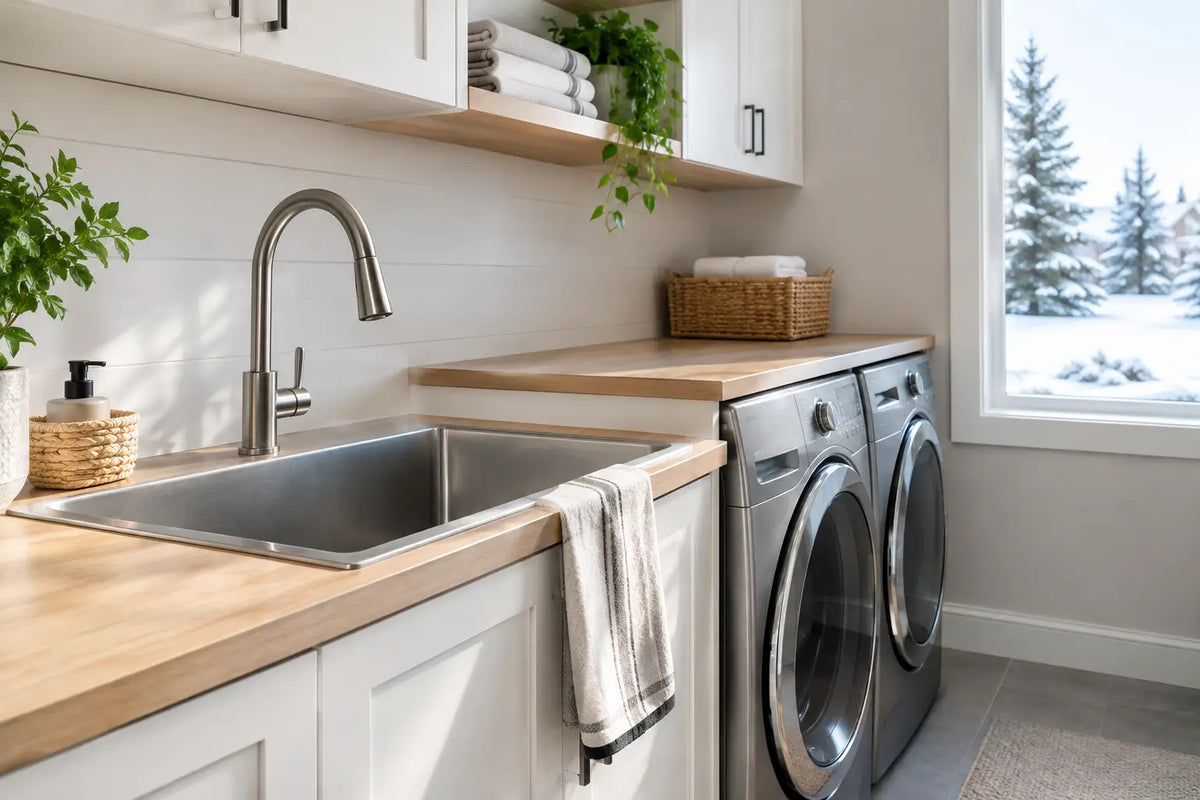
A laundry room sink earns its space when the work gets messy: rinsing paint rollers, soaking sports uniforms, filling mop buckets, washing a small pet, or cleaning up after a basement project. The best laundry sinks are not chosen only by appearance. Their bowl capacity, material, cabinet arrangement, faucet clearance and drain connection all affect how well the room works day after day.
For Canadian homeowners and trade buyers, the right choice usually comes down to one question: is the sink primarily a utility station, or does it need to coordinate with a finished laundry room renovation? Both needs can be met, but the ideal product specification changes considerably.
Start With How the Laundry Sink Will Be Used
A compact sink may be enough for hand-washing delicates and emptying a cleaning bucket. If the sink will handle large loads, muddy boots, pet washing or frequent soaking, choose a deeper, wider basin with an open work area around it. A shallow decorative sink can look appropriate in a finished room but become frustrating once a bulky item needs to be rinsed.
Measure more than the available cabinet width. Confirm the bowl's interior dimensions, overall depth from the wall, and the clearance needed to stand comfortably in front of it. In a narrow laundry room, a sink that projects too far can interfere with appliance doors, walkways or access to a floor drain.
Also consider what shares the room. Side-by-side washers and dryers often leave room for a base cabinet and sink, while stacked appliances can create more flexibility for a larger utility station. In a combined mudroom and laundry area, a generous sink may serve as the main cleanup point for the household.
Laundry Sinks by Material
Material affects durability, maintenance and the visual finish of the room. There is no single best option for every installation.
Stainless Steel
Stainless steel is a practical choice for laundry rooms that see regular hard use. It resists corrosion, handles temperature changes well and pairs easily with contemporary appliances, chrome faucets and industrial-style shelving. A deeper-gauge stainless steel sink is generally quieter and more resistant to dents than a lighter-gauge option.
Its trade-off is water spotting and visible scratches. These are typically cosmetic rather than functional, but they can matter in a design-focused laundry room. A brushed finish helps reduce the appearance of everyday marks.
Composite and Granite Composite
Composite sinks offer a substantial feel and a more refined appearance than many basic utility basins. Available in neutral tones such as black, grey and white, they can coordinate with stone-look counters and modern cabinetry. Their dense construction stands up well to many daily tasks and makes them suitable for a finished renovation.
Before selecting a composite model, verify cabinet support, faucet-hole configuration and recommended cleaning products. Some harsh chemicals, dyes and abrasive cleaners may affect the finish over time. This is especially relevant where the sink will be used for painting or stain-related cleanup.
Fireclay and Ceramic
Fireclay and ceramic laundry sinks suit traditional, farmhouse and elevated utility-room designs. They offer a bright, clean surface and can make a laundry room feel like an integrated part of the home rather than a purely functional back room. Apron-front styles are especially effective where the sink is intended to be a design feature.
These materials are heavy and need proper cabinet or framing support. They can also chip if struck by heavy metal tools or dropped objects. They are better suited to planned renovation layouts than quick replacement projects.
Polypropylene and Utility Plastic
Polypropylene utility sinks remain a dependable, cost-conscious option for basements, garages, workshops and rental properties. They are lightweight, easy to clean and generally generous in capacity. Many are sold as freestanding units with legs, a basic faucet deck and open storage below.
The finish is less decorative, and plastic can flex more than metal or stone-based materials. Still, for a straightforward work sink, it is often the most efficient solution.
Choose the Right Mounting Style
Freestanding laundry tubs are common where speed, capacity and service access matter most. Their open base makes drain and supply connections easier to reach, and they are well suited to unfinished or semi-finished spaces. Look for adjustable legs when the floor is uneven, and plan for proper anchoring where required.
Drop-in and undermount sinks work best with a countertop and base cabinet. A drop-in sink has a visible rim that rests on the counter, while an undermount sink installs below the countertop for a cleaner edge and easier wipe-down. Undermount installations require a compatible counter material and secure support, particularly with heavier sink materials.
Wall-mounted sinks can preserve floor space in compact rooms. They need solid blocking or structural support behind the finished wall, not just drywall anchors. Confirm the mounting hardware, load rating and plumbing location before closing the wall.
An apron-front sink is a cabinet-driven choice. It projects through the front of the cabinet and requires a purpose-built base or modified cabinet opening. It can create a premium focal point, but it is less forgiving of measurement errors than a standard drop-in installation.
Plan the Faucet, Drain and Rough-In Details
A laundry sink is only as useful as its faucet. A high-arc spout improves access to deep bowls and tall buckets, while a pull-down or pull-out spray head makes rinsing corners, fabric and cleaning tools easier. For very large utility tubs, check the spout reach. A faucet that is too short may leave the rear of the basin difficult to use.
Confirm whether the sink includes faucet holes and how many it has. A single-hole sink is suited to a modern single-handle faucet. Three-hole configurations may accommodate a widespread faucet, a two-handle model or a single-handle faucet with an escutcheon plate. The faucet must match the hole spacing and deck thickness.
Drain position matters as well. A centre drain is common and straightforward, but an offset drain can provide more usable space inside the cabinet. Check whether the sink requires a standard basket strainer, a specific drain assembly or an included overflow connection. Not every laundry sink includes an overflow, and local plumbing requirements and installation conditions should be reviewed before purchase.
For renovation projects, inspect the existing rough-in before choosing the sink cabinet. Water supply valves, drain height, trap location and cleanout access can all affect the usable space below the basin. In many cases, a cabinet that looks wide enough on paper becomes tight once supply lines and a P-trap are installed.
Size, Depth and Cabinet Storage
Laundry sinks are often selected by overall width alone, but bowl depth is equally important. A deep basin reduces splashing and accommodates larger cleaning tasks. It also places the working surface lower, which may be uncomfortable for taller users if the sink is set in a standard-height cabinet.
A practical compromise is to choose the deepest basin that still leaves a comfortable rim height. For a dedicated pet-washing or utility station, capacity may matter more than ergonomics. For a laundry room used daily for hand-washing and folding, counter height and reach deserve more attention.
Closed cabinetry keeps detergents, spare parts and cleaning supplies out of sight, while an open-base sink offers easier service access and room for bins or baskets. If storage is a priority, leave enough space around the plumbing for cabinet organizers to function. A full-depth drawer directly under a sink is rarely practical without a purpose-designed plumbing cutout.
Details That Prevent Installation Problems
Before ordering, compare the product specification with the site conditions. Record the available width, depth and height; existing drain centreline; water-line locations; countertop thickness; faucet-hole requirements; and the swing of nearby doors and appliances. If the sink is being installed on an upper floor, confirm the route through stairs, halls and doorways, especially for fireclay or oversized models.
For contractors and property managers, replacement compatibility can be more valuable than a complete layout change. Matching the existing drain location and cabinet footprint may reduce labour and avoid unnecessary wall or flooring repairs. For a full renovation, it can be worth moving the rough-in to gain a deeper basin, better storage or a more useful faucet position.
Select trusted fixtures and compatible installation components together rather than treating the sink as a standalone purchase. Plumbing Market carries laundry-room fixtures, faucets, drains, valves and replacement parts across residential and commercial applications, making it easier to specify a coordinated setup.
A well-chosen laundry sink should make the jobs people avoid feel manageable. Prioritize the tasks it must handle, verify every measurement before installation, and choose a material and mounting style that suits the room's actual workload.